2. consider the functions f(x)=cos x and g(x)=cos 4x. 2b complete the table of values for g(x). 2c state the…
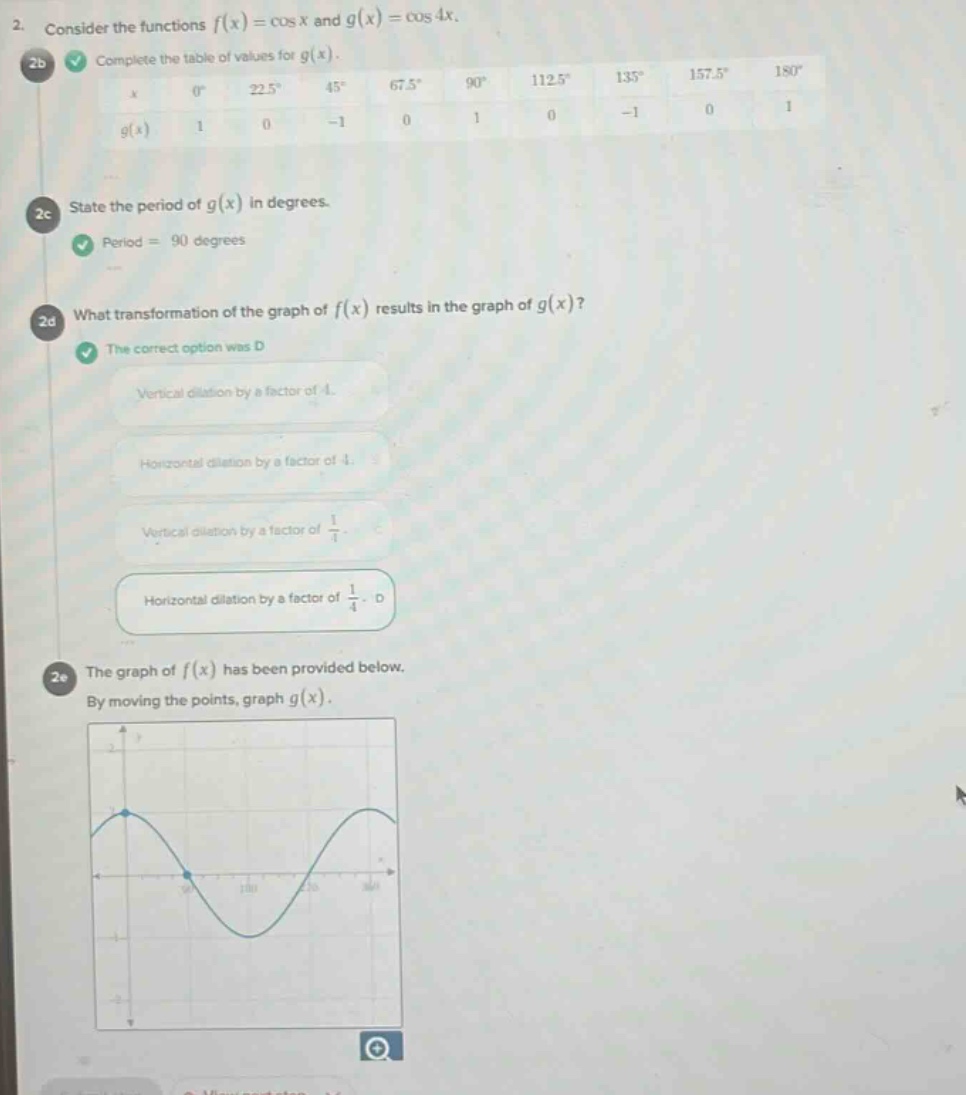
2. consider the functions f(x)=cos x and g(x)=cos 4x. 2b complete the table of values for g(x). 2c state the period of g(x) in degrees. 2d what transformation of the graph of f(x) results in the graph of g(x)? 2e the graph of f(x) has been provided below. by moving the points, graph g(x).
Answer
Explanation:
Step1: Recall cosine - function properties
The general form of a cosine function is $y = A\cos(Bx - C)+D$. For $g(x)=\cos(4x)$, $A = 1$, $B = 4$, $C = 0$, $D = 0$.
Step2: Find the period formula
The period of a cosine function $y=\cos(Bx)$ is given by $T=\frac{360^{\circ}}{|B|}$.
Step3: Calculate the period of $g(x)$
Since $B = 4$, then $T=\frac{360^{\circ}}{4}=90^{\circ}$.
Step4: Analyze graph - transformation
For the functions $f(x)=\cos(x)$ and $g(x)=\cos(4x)$, when we go from $y = \cos(x)$ to $y=\cos(4x)$, we replace $x$ with $4x$. This is a horizontal dilation. If we have $y = f(bx)$ where $b>1$, the graph of $y = f(x)$ is horizontally dilated by a factor of $\frac{1}{b}$. Here $b = 4$, so the graph of $f(x)$ is horizontally dilated by a factor of $\frac{1}{4}$ to get the graph of $g(x)$.
Answer:
The period of $g(x)$ is $90$ degrees. The transformation from the graph of $f(x)$ to the graph of $g(x)$ is a horizontal dilation by a factor of $\frac{1}{4}$.