consider the graph of the function f that is defined by the equation f(x)=(x^3 - x^2 - 12x)/(x^2 + 2x - 3)…
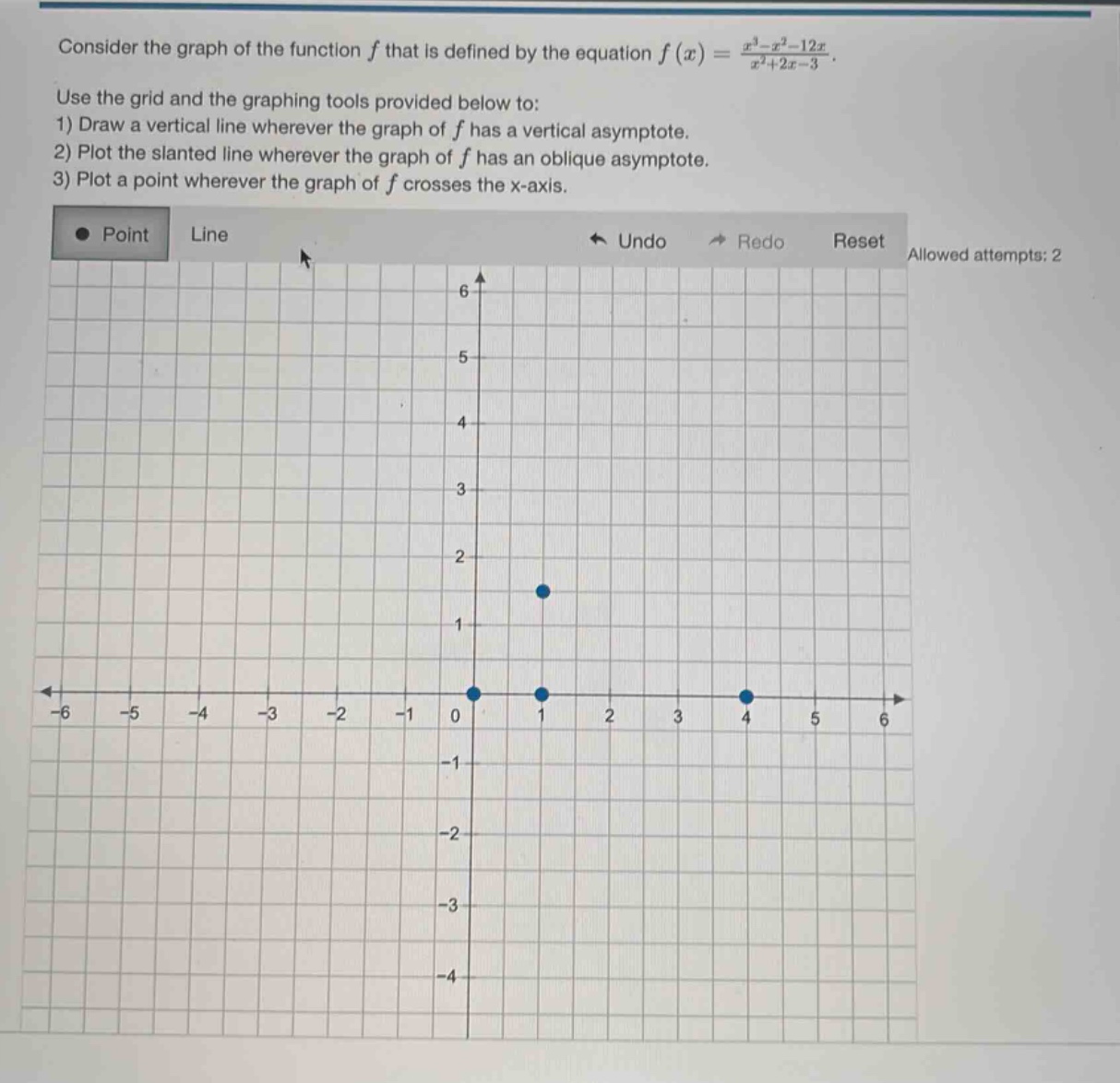
consider the graph of the function f that is defined by the equation f(x)=(x^3 - x^2 - 12x)/(x^2 + 2x - 3). use the grid and the graphing tools provided below to: 1) draw a vertical line wherever the graph of f has a vertical asymptote. 2) plot the slanted line wherever the graph of f has an oblique asymptote. 3) plot a point wherever the graph of f crosses the x - axis. point line undo redo reset allowed attempts: 2
Answer
Explanation:
Step1: Find vertical asymptotes
Set the denominator $x^{2}+2x - 3=(x + 3)(x - 1)=0$. Solving gives $x=-3$ and $x = 1$. These are the equations of the vertical - asymptotes.
Step2: Find oblique asymptote
Use polynomial long - division. Divide $x^{3}-x^{2}-12x$ by $x^{2}+2x - 3$. The quotient is $x-3$. So the equation of the oblique asymptote is $y=x - 3$.
Step3: Find x - intercepts
Set the numerator $x^{3}-x^{2}-12x=x(x^{2}-x - 12)=x(x - 4)(x+3)=0$. The solutions are $x = 0$, $x=4$ and $x=-3$. But $x=-3$ makes the denominator zero, so the x - intercepts are at $x = 0$ and $x = 4$.
Answer:
- Draw vertical lines at $x=-3$ and $x = 1$.
- Plot the line $y=x - 3$.
- Plot points at $(0,0)$ and $(4,0)$.