consider the graph of the function f that is defined by the equation f(x) = (2x³ - 8x)/(x² - x). use the…
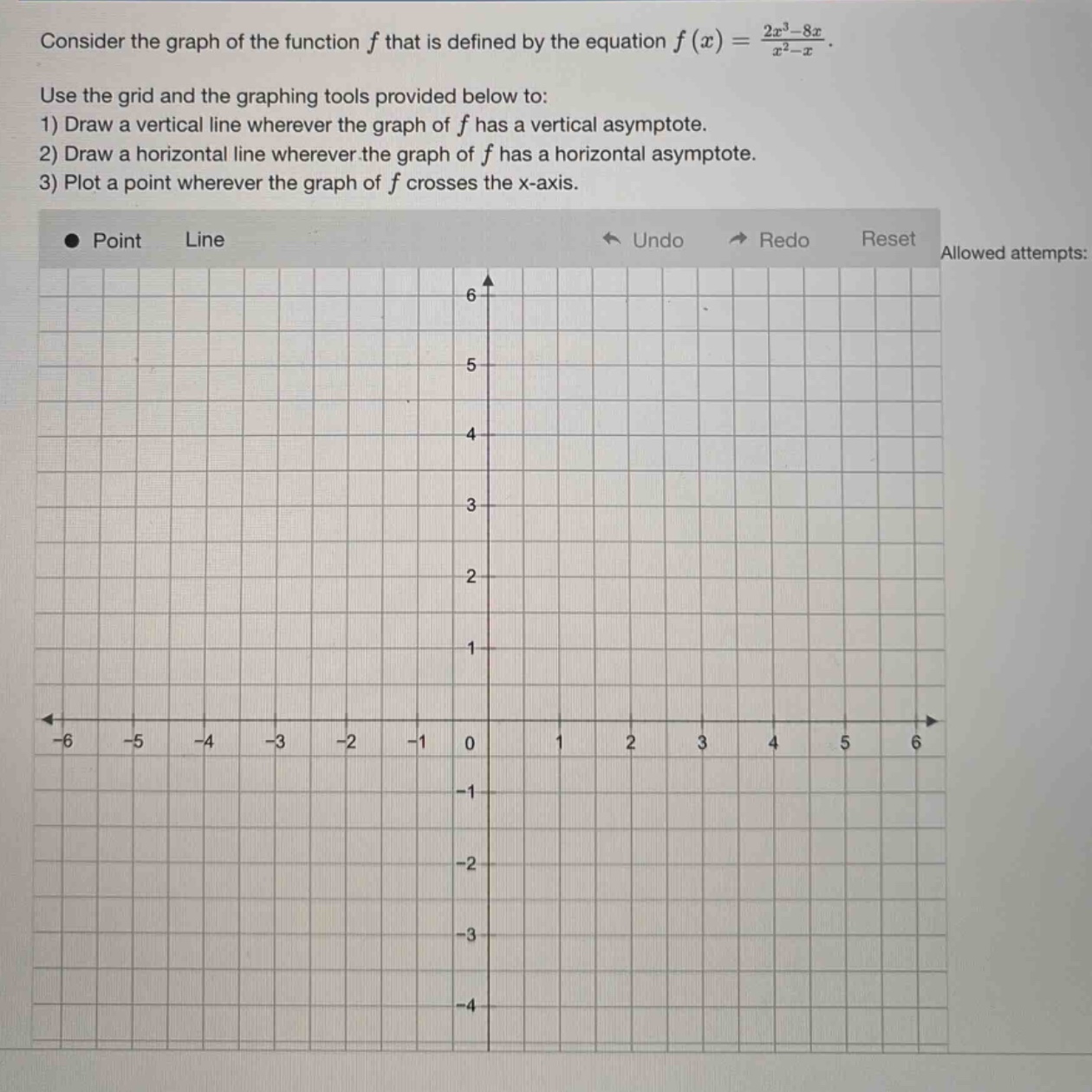
consider the graph of the function f that is defined by the equation f(x) = (2x³ - 8x)/(x² - x). use the grid and the graphing tools provided below to: 1) draw a vertical line wherever the graph of f has a vertical asymptote. 2) draw a horizontal line wherever the graph of f has a horizontal asymptote. 3) plot a point wherever the graph of f crosses the x - axis. point line undo redo reset allowed attempts:
Answer
Explanation:
Step1: Simplify the function
First, factor the numerator and denominator. $f(x)=\frac{2x^3 - 8x}{x^2 - x}=\frac{2x(x^2 - 4)}{x(x - 1)}=\frac{2x(x - 2)(x + 2)}{x(x - 1)}$, $x\neq0$. After canceling out the non - zero $x$ terms, $f(x)=\frac{2(x - 2)(x + 2)}{x - 1}=\frac{2(x^2-4)}{x - 1}=\frac{2x^2-8}{x - 1}$ for $x\neq0$.
Step2: Find vertical asymptotes
Vertical asymptotes occur where the denominator of the simplified function is zero. Set $x - 1=0$, so $x = 1$ is a vertical asymptote. Also, we need to consider the original domain restriction $x = 0$. So the vertical asymptotes are $x=0$ and $x = 1$.
Step3: Find horizontal asymptotes
Since the degree of the numerator ($n = 2$) is one more than the degree of the denominator ($m=1$), we use long - division or the fact that $\lim_{x\rightarrow\pm\infty}\frac{2x^2-8}{x - 1}=\lim_{x\rightarrow\pm\infty}(2x + 2+\frac{- 6}{x - 1})$. There is no horizontal asymptote.
Step4: Find x - intercepts
Set $y = f(x)=0$. Then $\frac{2x^3 - 8x}{x^2 - x}=0$. Since $f(x)=\frac{2x(x - 2)(x + 2)}{x(x - 1)}$, setting the numerator equal to zero (while considering $x\neq0$), we get $x=-2$ and $x = 2$ as the x - intercepts.
Answer:
- Draw vertical lines at $x = 0$ and $x=1$.
- Do not draw a horizontal line (no horizontal asymptote).
- Plot points at $(-2,0)$ and $(2,0)$.