consider the graph of the function f(x)=e^x. what is the range of function g if g(x)=f(x)+3? a. (3, ∞) b…
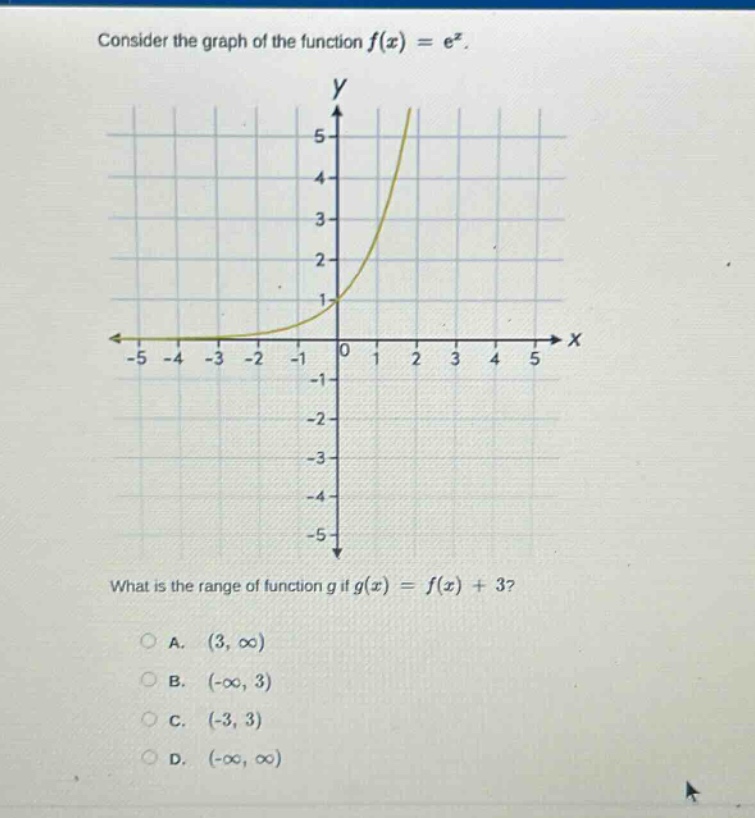
consider the graph of the function f(x)=e^x. what is the range of function g if g(x)=f(x)+3? a. (3, ∞) b. (-∞, 3) c. (-3, 3) d. (-∞, ∞)
Answer
Explanation:
Step1: Recall range of $f(x)$
The range of $y = e^{x}$ is $(0,\infty)$ since $e^{x}>0$ for all real - valued $x$.
Step2: Analyze $g(x)$
Given $g(x)=f(x)+3 = e^{x}+3$. Let $y = g(x)$. Then $y=e^{x}+3$. Since $e^{x}>0$, we have $y=e^{x}+3>3$.
Answer:
A. $(3,\infty)$