consider the graph of $f(x)$ given below. at what value(s) of $x$ does $f(x)$ have a local minimum? if there…
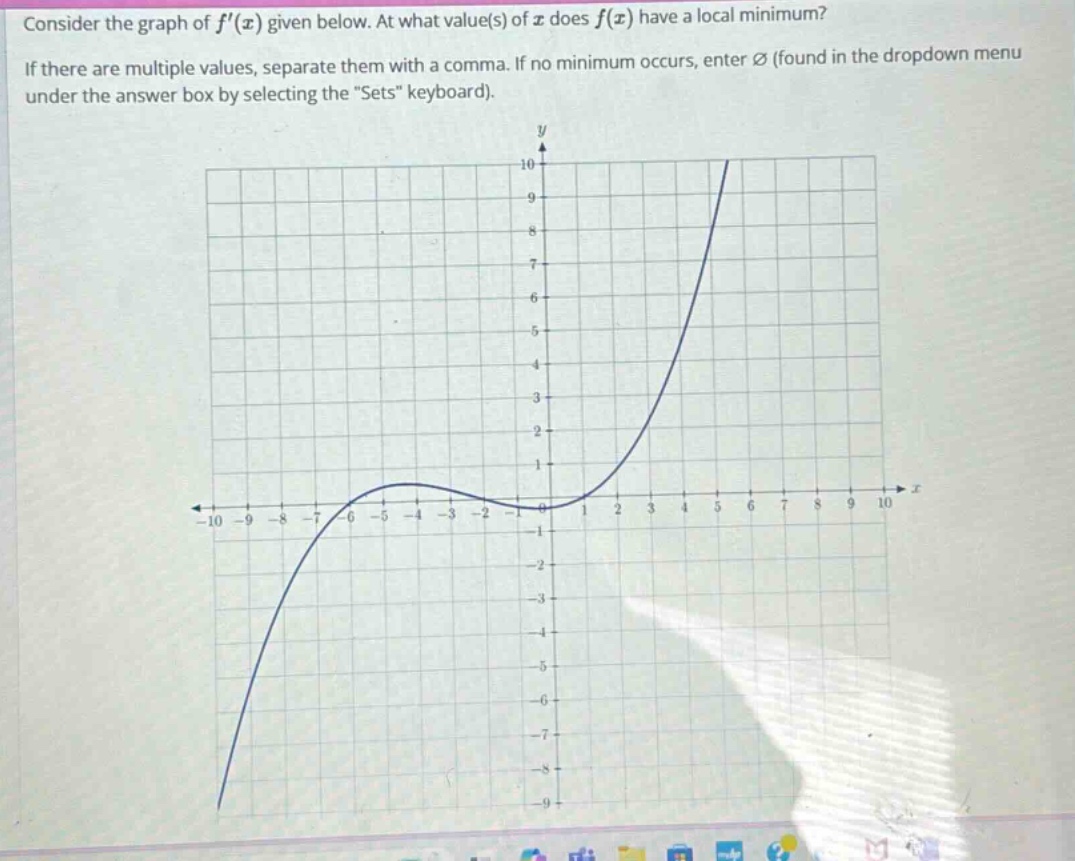
consider the graph of $f(x)$ given below. at what value(s) of $x$ does $f(x)$ have a local minimum? if there are multiple values, separate them with a comma. if no minimum occurs, enter $varnothing$ (found in the dropdown menu under the answer box by selecting the \sets\ keyboard).
Answer
Explanation:
Step1: Identify critical points.
Critical points of $f(x)$ occur where $f'(x) = 0$ or $f'(x)$ is undefined. From the graph, $f'(x) = 0$ at $x = -6$, $x = -1$, and $x = 1$.
Step2: Determine the sign of $f'(x)$ around critical points.
A local minimum occurs where $f'(x)$ changes from negative to positive.
- For $x < -6$, $f'(x) < 0$.
- For $-6 < x < -1$, $f'(x) > 0$. Thus, at $x = -6$, $f'(x)$ changes from negative to positive.
- For $-1 < x < 1$, $f'(x) < 0$. Thus, at $x = -1$, $f'(x)$ changes from positive to negative (local maximum).
- For $x > 1$, $f'(x) > 0$. Thus, at $x = 1$, $f'(x)$ changes from negative to positive.
Step3: Conclude the local minima.
Based on the sign changes of $f'(x)$, local minima occur at $x = -6$ and $x = 1$.
Answer:
-6, 1