consider the graph of the polar function r = f(θ), where f(θ)=2sinθ - 1, in the polar coordinate system…
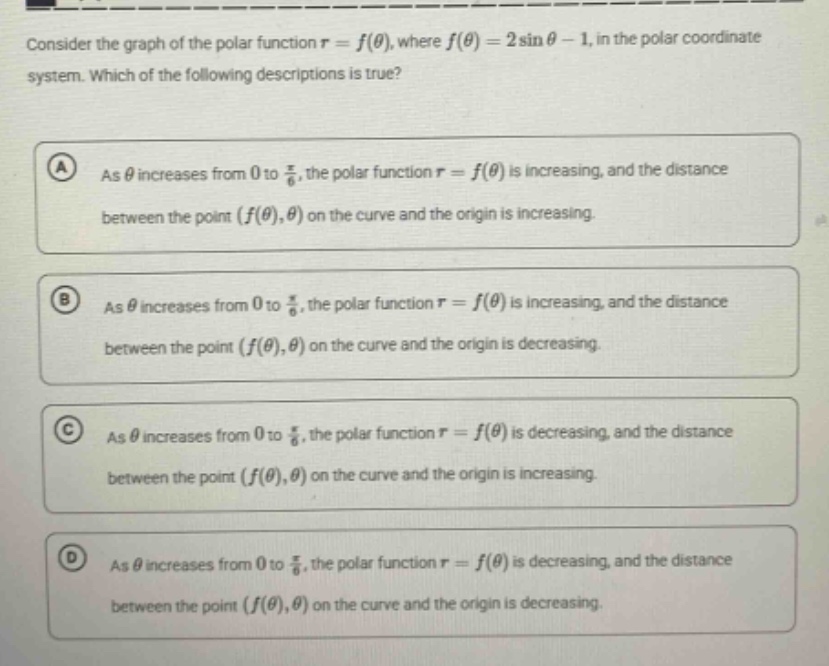
consider the graph of the polar function r = f(θ), where f(θ)=2sinθ - 1, in the polar coordinate system. which of the following descriptions is true? a as θ increases from 0 to π/6, the polar function r = f(θ) is increasing, and the distance between the point (f(θ),θ) on the curve and the origin is increasing. b as θ increases from 0 to π/6, the polar function r = f(θ) is increasing, and the distance between the point (f(θ),θ) on the curve and the origin is decreasing. c as θ increases from 0 to π/6, the polar function r = f(θ) is decreasing, and the distance between the point (f(θ),θ) on the curve and the origin is increasing. d as θ increases from 0 to π/6, the polar function r = f(θ) is decreasing, and the distance between the point (f(θ),θ) on the curve and the origin is decreasing.
Answer
Explanation:
Step1: Find the derivative of (r = f(\theta))
We have (r=f(\theta)=2\sin\theta - 1). Using the derivative formula for (\sin\theta), (r'=f'(\theta)=2\cos\theta).
Step2: Evaluate (r') on the interval (\theta\in[0,\frac{\pi}{6}])
When (\theta\in[0,\frac{\pi}{6}]), (\cos\theta> 0). Since (r' = 2\cos\theta>0) for (\theta\in[0,\frac{\pi}{6}]), the function (r = f(\theta)) is increasing on the interval (\theta\in[0,\frac{\pi}{6}]).
Step3: Analyze the distance from the origin
In polar - coordinates, the distance between the point ((r,\theta)=(f(\theta),\theta)) and the origin is given by (|r| = |2\sin\theta - 1|). When (\theta = 0), (r=2\sin(0)-1=- 1), (|r| = 1). When (\theta=\frac{\pi}{6}), (r=2\sin(\frac{\pi}{6})-1=2\times\frac{1}{2}-1 = 0), (|r|) is decreasing on the interval (\theta\in[0,\frac{\pi}{6}]).
Answer:
B. As (\theta) increases from (0) to (\frac{\pi}{6}), the polar function (r = f(\theta)) is increasing, and the distance between the point ((f(\theta),\theta)) on the curve and the origin is decreasing.