consider the graph of the polar function r = f(θ), where f(θ) = 5cos(2θ), in the polar coordinate system for…
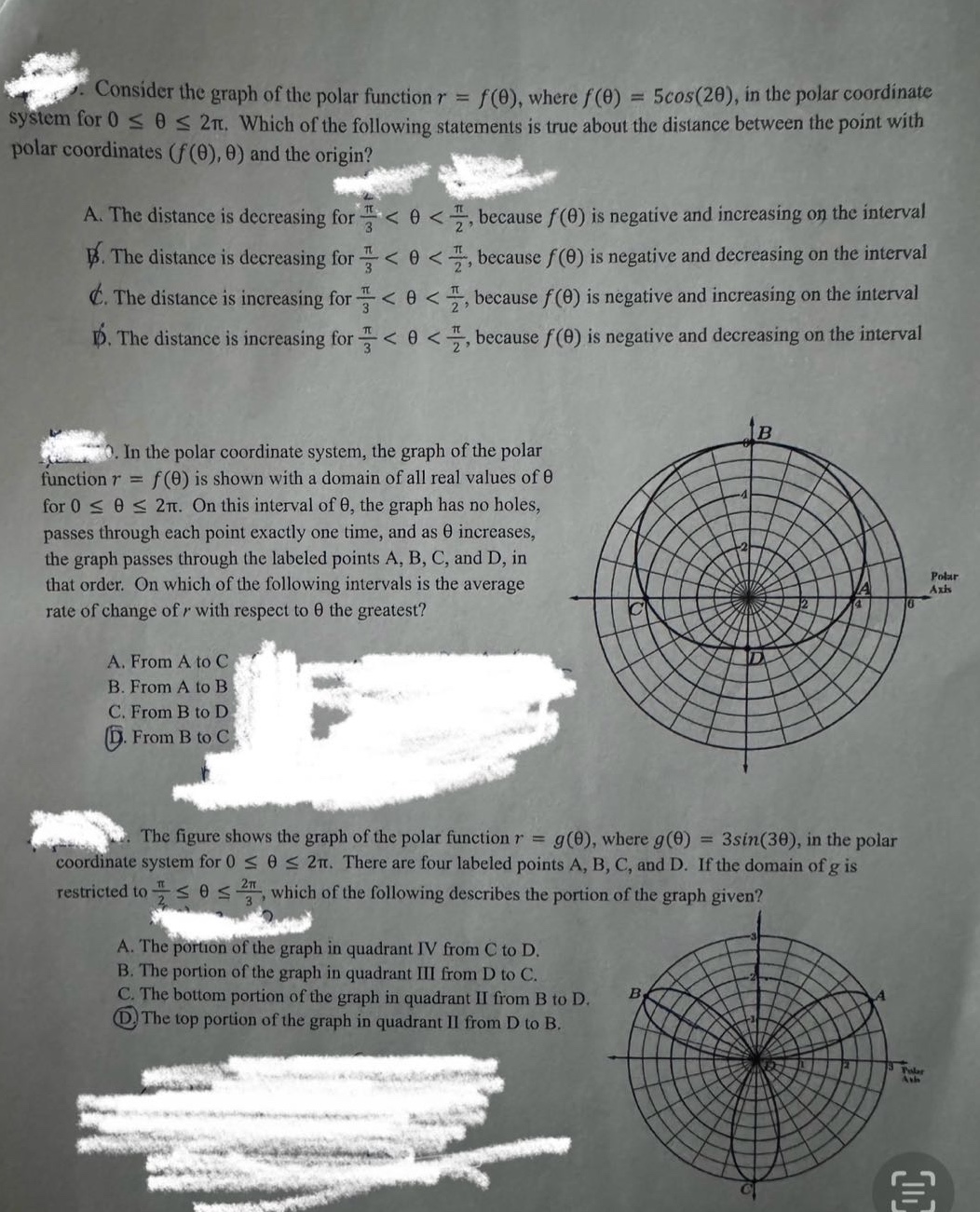
consider the graph of the polar function r = f(θ), where f(θ) = 5cos(2θ), in the polar coordinate system for 0 ≤ θ ≤ 2π. which of the following statements is true about the distance between the point with polar coordinates (f(θ), θ) and the origin? a. the distance is decreasing for π/3 < θ < π/2, because f(θ) is negative and increasing on the interval b. the distance is decreasing for π/3 < θ < π/2, because f(θ) is negative and decreasing on the interval c. the distance is increasing for π/3 < θ < π/2, because f(θ) is negative and increasing on the interval d. the distance is increasing for π/3 < θ < π/2, because f(θ) is negative and decreasing on the interval in the polar coordinate system, the graph of the polar function r = f(θ) is shown with a domain of all real values of θ for 0 ≤ θ ≤ 2π. on this interval of θ, the graph has no holes, passes through each point exactly one time, and as θ increases, the graph passes through the labeled points a, b, c, and d, in that order. on which of the following intervals is the average rate of change of r with respect to θ the greatest? a. from a to c b. from a to b c. from b to d d. from b to c the figure shows the graph of the polar function r = g(θ), where g(θ) = 3sin(3θ), in the polar coordinate system for 0 ≤ θ ≤ 2π. there are four labeled points a, b, c, and d. if the domain of g is restricted to π/2 ≤ θ ≤ 2π/3, which of the following describes the portion of the graph given? a. the portion of the graph in quadrant iv from c to d. b. the portion of the graph in quadrant iii from d to c. c. the bottom portion of the graph in quadrant ii from b to d. d. the top portion of the graph in quadrant ii from d to b.
Answer
Explanation:
Question 1:
- Recall that in polar - coordinates, the distance between a point $(r,\theta)$ and the origin is given by $|r|$. Here, $r = f(\theta)=5\cos(2\theta)$.
- First, find the sign and behavior of $y = f(\theta)=5\cos(2\theta)$ on the interval $\frac{\pi}{3}<\theta<\frac{\pi}{2}$. Let $u = 2\theta$, then when $\theta=\frac{\pi}{3}$, $u=\frac{2\pi}{3}$ and when $\theta=\frac{\pi}{2}$, $u = \pi$. The function $y = 5\cos(u)$ is negative and increasing on the interval $\frac{2\pi}{3}<u<\pi$. Since $r = f(\theta)$ and the distance from the origin is $|r|$, when $r$ is negative and increasing, $|r|$ is decreasing.
Question 2:
- The average rate of change of $r$ with respect to $\theta$ is given by $\frac{\Delta r}{\Delta\theta}=\frac{r_2 - r_1}{\theta_2-\theta_1}$.
- Visually, the average rate of change is the slope of the secant - line connecting two points on the polar curve. By observing the polar graph, the secant - line from $A$ to $B$ has the steepest slope among the given intervals.
Question 3:
- When $\theta=\frac{\pi}{2}$, $g(\theta)=3\sin(3\theta)=3\sin(\frac{3\pi}{2})=- 3$. When $\theta=\frac{2\pi}{3}$, $g(\theta)=3\sin(3\times\frac{2\pi}{3})=3\sin(2\pi)=0$.
- As $\theta$ increases from $\frac{\pi}{2}$ to $\frac{2\pi}{3}$, and considering the polar - coordinate system and the function $r = 3\sin(3\theta)$, the portion of the graph lies in the second quadrant and moves from a point with a non - zero negative $r$ value (point $D$) to $r = 0$ (point $B$), which is the top portion of the graph in quadrant II from $D$ to $B$.
Answer:
- A. The distance is decreasing for $\frac{\pi}{3}<\theta<\frac{\pi}{2}$, because $f(\theta)$ is negative and increasing on the interval.
- B. From A to B
- D. The top portion of the graph in quadrant II from D to B.