consider the graph of f and f shown to the right. on the same set of axes, sketch the graph of a possible…
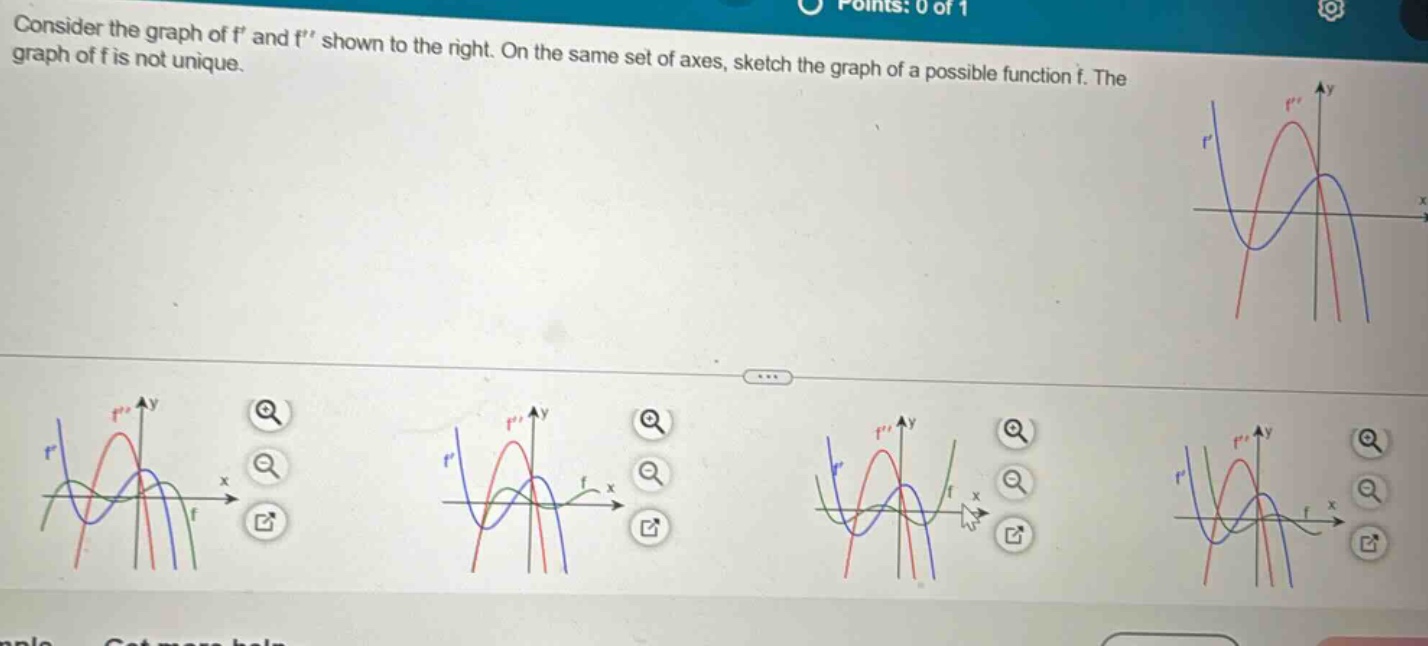
consider the graph of f and f shown to the right. on the same set of axes, sketch the graph of a possible function f. the graph of f is not unique.
Answer
Explanation:
Step1: Analyze (f') for increasing - decreasing
When (f'(x)>0), (f(x)) is increasing. When (f'(x) < 0), (f(x)) is decreasing.
Step2: Analyze (f'') for concavity
When (f''(x)>0), (f(x)) is concave - up. When (f''(x)<0), (f(x)) is concave - down. Inflection points of (f(x)) occur where (f''(x) = 0).
Step3: Sketch the function
Start with an initial point (arbitrary since the graph of (f) is not unique). Use the information from (f') and (f'') to draw a smooth curve. For example, if (f') is positive and (f'') is positive, draw an increasing and concave - up curve; if (f') is positive and (f'') is negative, draw an increasing and concave - down curve; if (f') is negative and (f'') is positive, draw a decreasing and concave - up curve; if (f') is negative and (f'') is negative, draw a decreasing and concave - down curve.
Since no specific graph of (f') and (f'') values are given in text form to provide a numerical answer, the general steps for sketching are provided above. The actual sketch would be done on a set of axes using the rules about (f') and (f'') as described.