consider the graph of f(x). which statement is true about the function represented by the graph? as x…
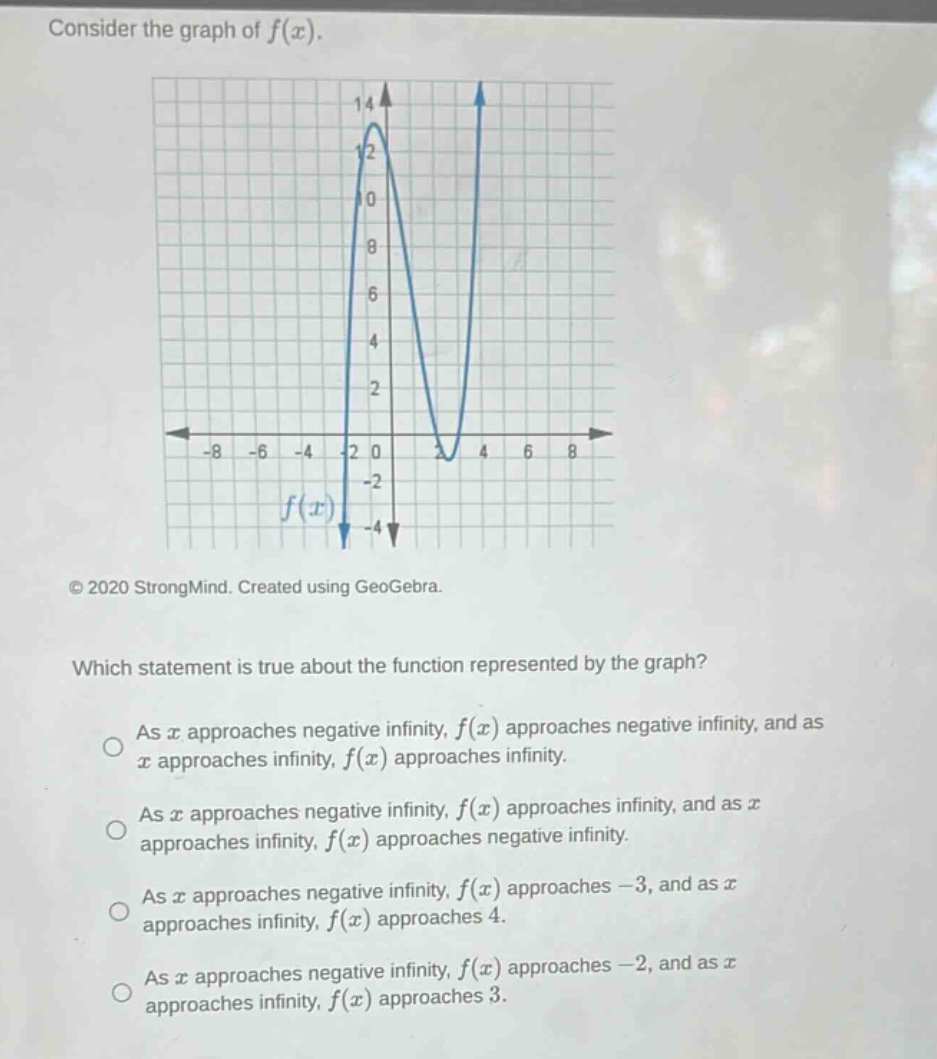
consider the graph of f(x). which statement is true about the function represented by the graph? as x approaches negative infinity, f(x) approaches negative infinity, and as x approaches infinity, f(x) approaches infinity. as x approaches negative infinity, f(x) approaches infinity, and as x approaches infinity, f(x) approaches negative infinity. as x approaches negative infinity, f(x) approaches -3, and as x approaches infinity, f(x) approaches 4. as x approaches negative infinity, f(x) approaches -2, and as x approaches infinity, f(x) approaches 3.
Answer
Explanation:
Step1: Analyze left - hand end behavior
As (x) approaches negative infinity ((x\to-\infty)), looking at the left - most part of the graph, the function (y = f(x)) is going downwards. So (f(x)\to-\infty) as (x\to-\infty).
Step2: Analyze right - hand end behavior
As (x) approaches positive infinity ((x\to+\infty)), looking at the right - most part of the graph, the function (y = f(x)) is going upwards. So (f(x)\to+\infty) as (x\to+\infty).
Answer:
As (x) approaches negative infinity, (f(x)) approaches negative infinity, and as (x) approaches infinity, (f(x)) approaches infinity.