consider the infinite series ∑(k = 1 to ∞) 1/(k + 1). evaluate the first four terms of the sequence of…
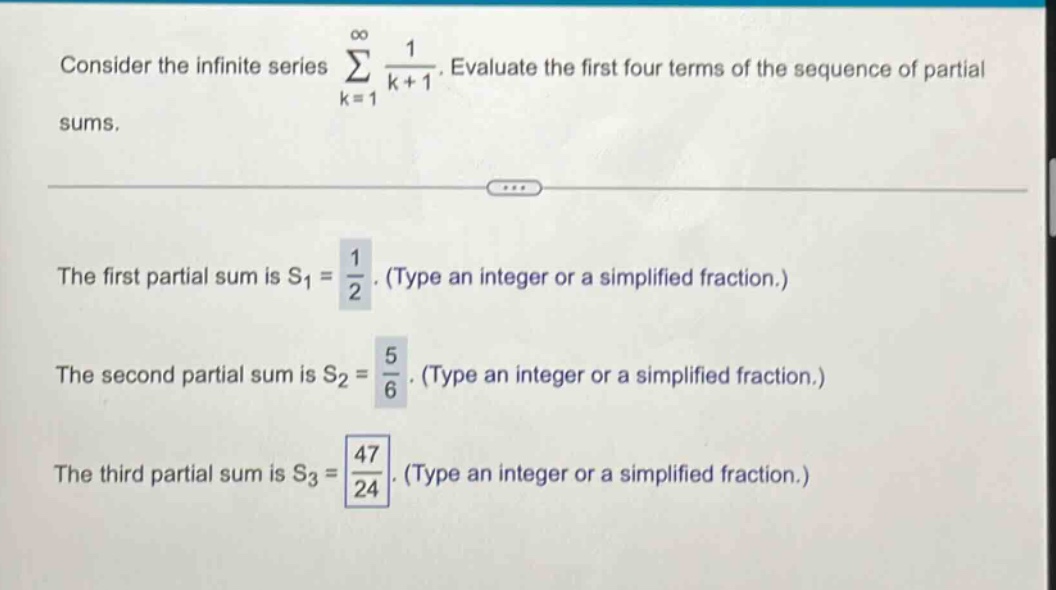
consider the infinite series ∑(k = 1 to ∞) 1/(k + 1). evaluate the first four terms of the sequence of partial sums. the first partial sum is s1 = 1/2. (type an integer or a simplified fraction.) the second partial sum is s2 = 5/6. (type an integer or a simplified fraction.) the third partial sum is s3 = 47/24. (type an integer or a simplified fraction.)
Answer
Explanation:
Step1: Define the series term
The series is $\sum_{k = 1}^{\infty}\frac{1}{k + 1}$, and the $n$-th partial - sum $S_n=\sum_{k = 1}^{n}\frac{1}{k + 1}$.
Step2: Calculate $S_1$
When $n = 1$, $S_1=\frac{1}{1+1}=\frac{1}{2}$.
Step3: Calculate $S_2$
$S_2=\frac{1}{2}+\frac{1}{3}=\frac{3 + 2}{6}=\frac{5}{6}$.
Step4: Calculate $S_3$
$S_3=\frac{1}{2}+\frac{1}{3}+\frac{1}{4}=\frac{6 + 4+3}{12}=\frac{13}{12}$. There is a mistake in the provided $S_3$ value.
Step5: Calculate $S_4$
$S_4=\frac{1}{2}+\frac{1}{3}+\frac{1}{4}+\frac{1}{5}=\frac{30 + 20+15 + 12}{60}=\frac{77}{60}$.
Answer:
$S_1=\frac{1}{2}$, $S_2=\frac{5}{6}$, $S_3=\frac{13}{12}$, $S_4=\frac{77}{60}$