consider the inverse sine function, defined by y = sin⁻¹x or y = arcsin x. complete parts (a) through (d)…
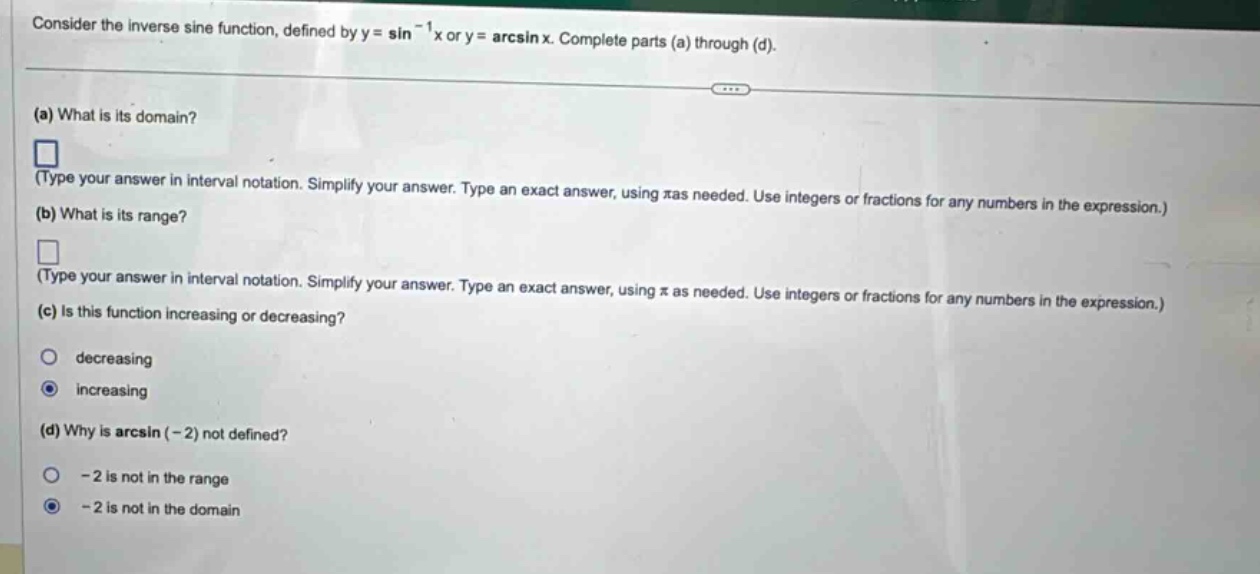
consider the inverse sine function, defined by y = sin⁻¹x or y = arcsin x. complete parts (a) through (d). (a) what is its domain? (type your answer in interval notation. simplify your answer. type an exact answer, using π as needed. use integers or fractions for any numbers in the expression.) (b) what is its range? (type your answer in interval notation. simplify your answer. type an exact answer, using π as needed. use integers or fractions for any numbers in the expression.) (c) is this function increasing or decreasing? decreasing increasing (d) why is arcsin( - 2) not defined? - 2 is not in the range - 2 is not in the domain
Answer
Explanation:
Step1: Recall domain of inverse - sine
The domain of the inverse - sine function $y = \sin^{-1}(x)$ or $y=\arcsin(x)$ is the set of values of $x$ for which the function is defined. Since the sine function $y = \sin(t)$ has a range of $[- 1,1]$, the domain of $y=\arcsin(x)$ is $[-1,1]$.
Step2: Recall range of inverse - sine
The range of the inverse - sine function $y=\arcsin(x)$ is the set of angles $y$ such that $y\in\left[-\frac{\pi}{2},\frac{\pi}{2}\right]$. This is because the sine function is one - to - one on the interval $\left[-\frac{\pi}{2},\frac{\pi}{2}\right]$.
Step3: Analyze the monotonicity
The derivative of $y = \arcsin(x)$ is $y'=\frac{1}{\sqrt{1 - x^{2}}}$, and for $x\in(-1,1)$, $y'>0$. So the function $y = \arcsin(x)$ is increasing on its domain $[-1,1]$.
Step4: Check the value for non - definition
Since the domain of $y=\arcsin(x)$ is $[-1,1]$, and $-2\notin[-1,1]$, $\arcsin(-2)$ is not defined.
Answer:
(a) $[-1,1]$ (b) $\left[-\frac{\pi}{2},\frac{\pi}{2}\right]$ (c) increasing (d) $-2$ is not in the domain