consider the polar functions r = f(θ) and r = g(θ), where f(θ)=1 + cos(θ + π/3) and g(θ)=1 + cos θ. which of…
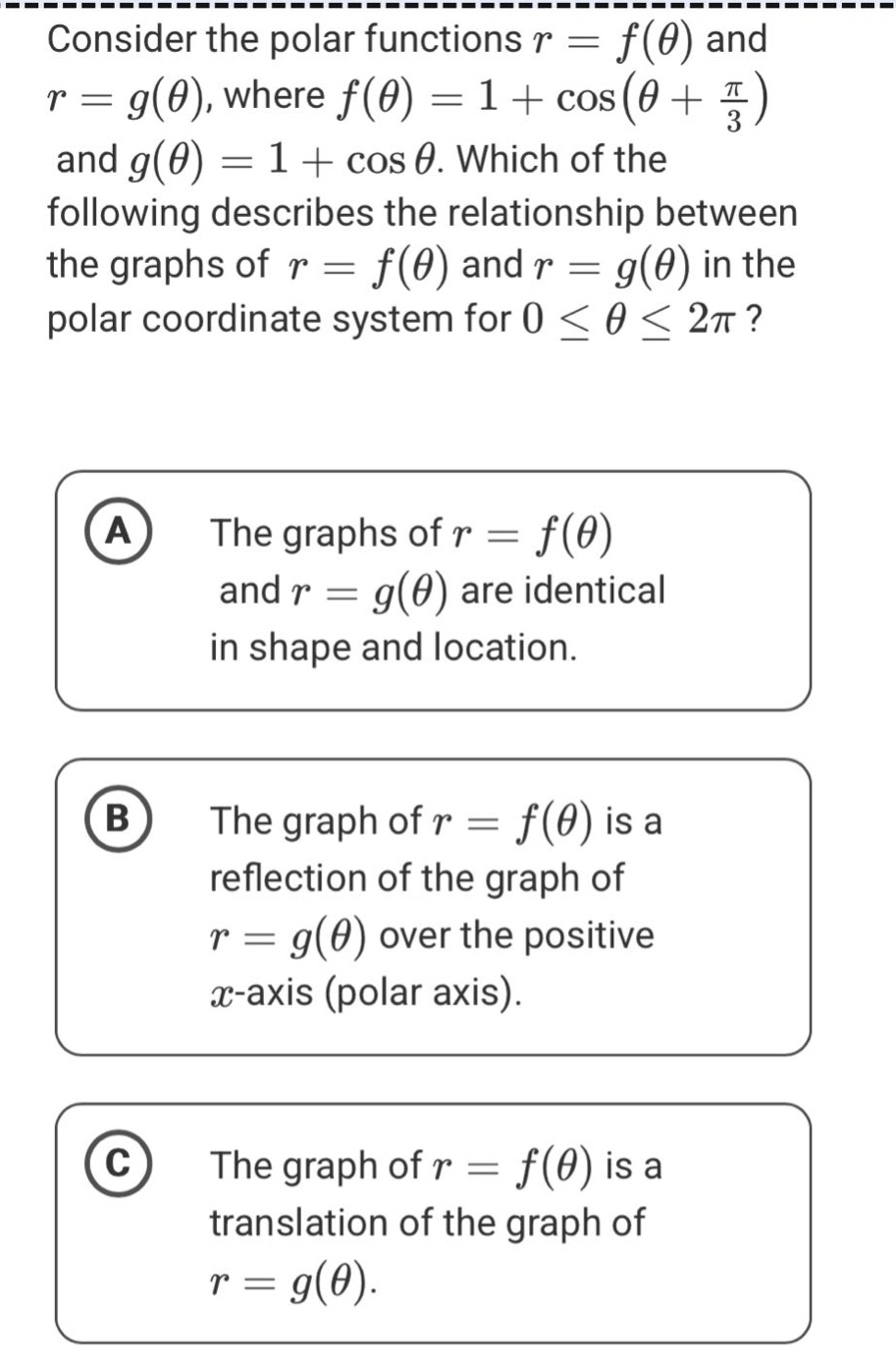
consider the polar functions r = f(θ) and r = g(θ), where f(θ)=1 + cos(θ + π/3) and g(θ)=1 + cos θ. which of the following describes the relationship between the graphs of r = f(θ) and r = g(θ) in the polar coordinate system for 0 ≤ θ ≤ 2π? a the graphs of r = f(θ) and r = g(θ) are identical in shape and location. b the graph of r = f(θ) is a reflection of the graph of r = g(θ) over the positive x - axis (polar axis). c the graph of r = f(θ) is a translation of the graph of r = g(θ).
Answer
Explanation:
Step1: Recall polar - function transformation rules
The general form of a polar - function transformation is $r = f(\theta - \alpha)$ represents a rotation of the graph of $r = f(\theta)$ by an angle $\alpha$ counter - clockwise about the origin. Here, $f(\theta)=1 + \cos(\theta+\frac{\pi}{3})$ and $g(\theta)=1 + \cos\theta$.
Step2: Analyze the transformation
The function $f(\theta)=1+\cos(\theta + \frac{\pi}{3})$ can be thought of as a transformation of $g(\theta)=1+\cos\theta$. The addition of $\frac{\pi}{3}$ inside the cosine function in $f(\theta)$ means that the graph of $r = f(\theta)$ is a rotation of the graph of $r = g(\theta)$ by an angle of $\frac{\pi}{3}$ counter - clockwise about the origin. A rotation is a type of translation in the polar coordinate system.
Answer:
C. The graph of $r = f(\theta)$ is a translation of the graph of $r = g(\theta)$.