consider the series ∑(k = 2 to ∞) 1 / (k(ln k)^p), where p is a real number. a. use the integral test to…
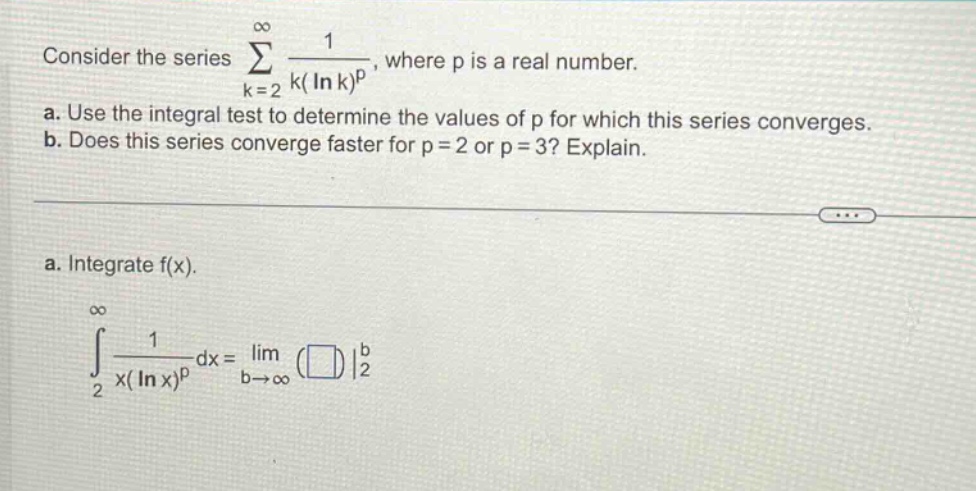
consider the series ∑(k = 2 to ∞) 1 / (k(ln k)^p), where p is a real number. a. use the integral test to determine the values of p for which this series converges. b. does this series converge faster for p = 2 or p = 3? explain. a. integrate f(x). ∫(2 to ∞) 1 / (x(ln x)^p) dx = lim(b→∞) (□)|2^b
Answer
Explanation:
Step1: Apply substitution
Let $u = \ln x$, then $du=\frac{1}{x}dx$. When $x = 2$, $u=\ln 2$; as $x\to\infty$, $u\to\infty$. So, $\int_{2}^{\infty}\frac{1}{x(\ln x)^{p}}dx=\int_{\ln 2}^{\infty}\frac{1}{u^{p}}du$.
Step2: Integrate $\frac{1}{u^{p}}$
The antiderivative of $u^{-p}$ is $\frac{u^{-p + 1}}{-p+1}$ for $p\neq1$ and $\ln u$ for $p = 1$. Case 1: If $p>1$ $$\int_{\ln 2}^{\infty}\frac{1}{u^{p}}du=\lim_{b\to\infty}\left[\frac{u^{-p + 1}}{-p + 1}\right]{\ln 2}^{b}=\lim{b\to\infty}\left(\frac{b^{-p + 1}}{-p + 1}-\frac{(\ln 2)^{-p + 1}}{-p + 1}\right)= \frac{(\ln 2)^{-p + 1}}{p - 1}$$ Case 2: If $p = 1$ $$\int_{\ln 2}^{\infty}\frac{1}{u}du=\lim_{b\to\infty}[\ln u]{\ln 2}^{b}=\lim{b\to\infty}(\ln b-\ln(\ln 2))=\infty$$ Case 3: If $p<1$ $$\int_{\ln 2}^{\infty}\frac{1}{u^{p}}du=\lim_{b\to\infty}\left[\frac{u^{-p + 1}}{-p + 1}\right]{\ln 2}^{b}=\lim{b\to\infty}\left(\frac{b^{-p + 1}}{-p + 1}-\frac{(\ln 2)^{-p + 1}}{-p + 1}\right)=\infty$$ So the series converges for $p>1$.
Step3: Analyze convergence - speed
The remainder $R_N$ of a series $\sum_{k = 2}^{\infty}a_k$ related to the integral $\int_{N}^{\infty}a(x)dx$. For the series $\sum_{k=2}^{\infty}\frac{1}{k(\ln k)^{p}}$, the remainder $R_N$ is related to $\int_{N}^{\infty}\frac{1}{x(\ln x)^{p}}dx$. Let $u=\ln x$, then $\int_{N}^{\infty}\frac{1}{x(\ln x)^{p}}dx=\int_{\ln N}^{\infty}\frac{1}{u^{p}}du$. For $p = 2$, $\int_{\ln N}^{\infty}\frac{1}{u^{2}}du=\lim_{b\to\infty}\left[-\frac{1}{u}\right]{\ln N}^{b}=\frac{1}{\ln N}$ For $p = 3$, $\int{\ln N}^{\infty}\frac{1}{u^{3}}du=\lim_{b\to\infty}\left[-\frac{1}{2u^{2}}\right]{\ln N}^{b}=\frac{1}{2(\ln N)^{2}}$ Since $\lim{N\to\infty}\frac{\frac{1}{2(\ln N)^{2}}}{\frac{1}{\ln N}}=\lim_{N\to\infty}\frac{1}{2\ln N}=0$, the series converges faster for $p = 3$.
Answer:
a. The series converges for $p>1$. b. The series converges faster for $p = 3$ because the remainder term $\int_{N}^{\infty}\frac{1}{x(\ln x)^{3}}dx=\frac{1}{2(\ln N)^{2}}$ decays faster than $\int_{N}^{\infty}\frac{1}{x(\ln x)^{2}}dx=\frac{1}{\ln N}$ as $N\to\infty$.