consider these sign charts for the first and second derivatives of a function f(x): f(x) - - - - - 0 + 0…
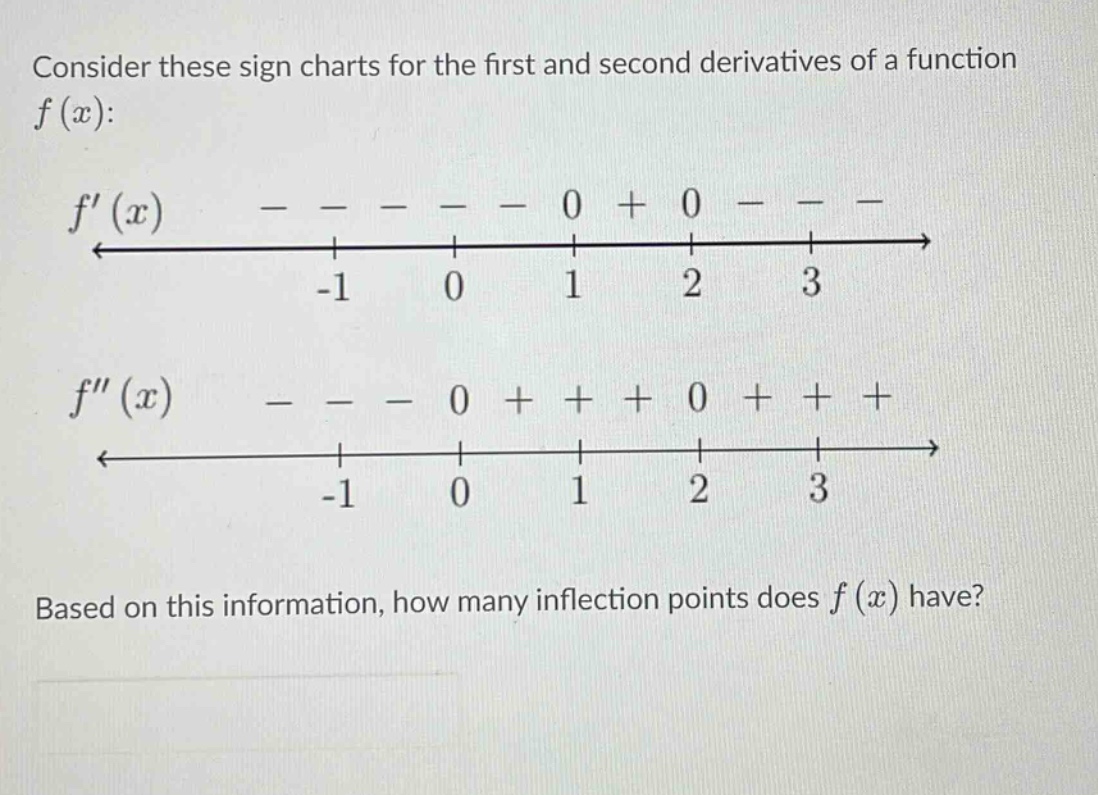
consider these sign charts for the first and second derivatives of a function f(x): f(x) - - - - - 0 + 0 - - - <-- -1 0 1 2 3 f(x) - - - 0 + + + 0 + + + <-- -1 0 1 2 3 based on this information, how many inflection points does f(x) have?
Answer
Explanation:
Step1: Recall inflection - point definition
An inflection point of a function $y = f(x)$ occurs where the second - derivative $f''(x)$ changes sign.
Step2: Analyze the sign of $f''(x)$
From the sign chart of $f''(x)$, we see that $f''(x)$ changes sign at $x=-1$ (from negative to positive) and at $x = 1$ (from positive to negative).
Answer:
2