consider the table representing a rational function.\n| x | -0.2 | -0.1 | 0 | 0.1 | 0.2 | 3.7 | 3.8 | 3.9 |…
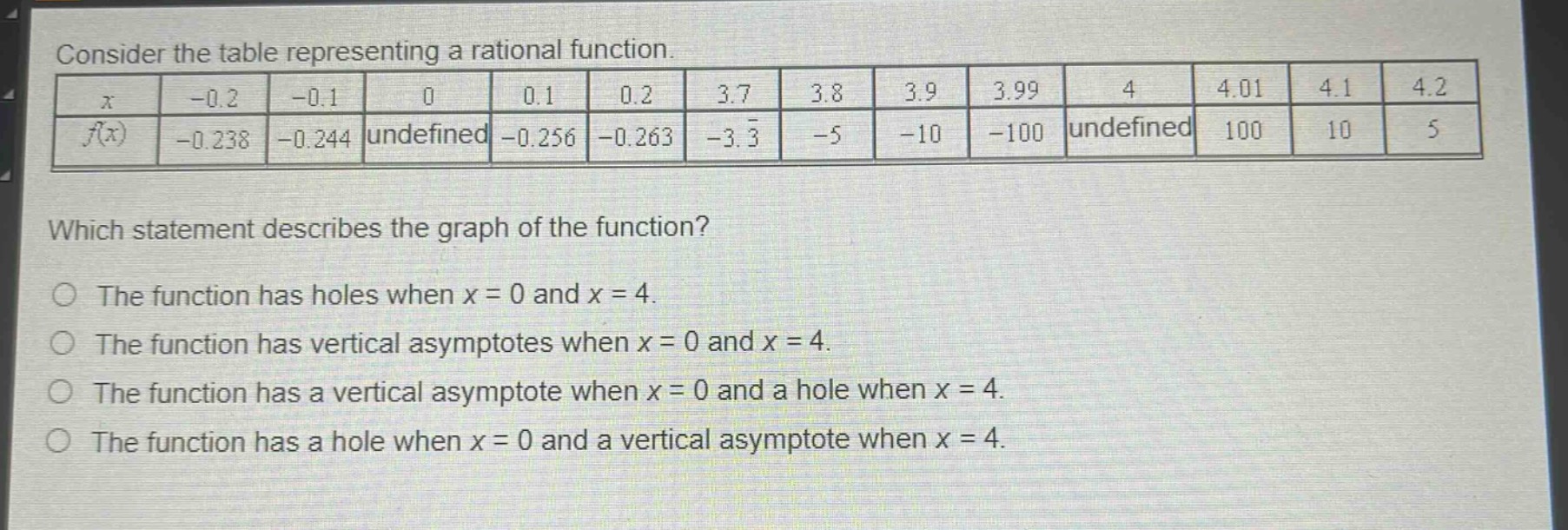
consider the table representing a rational function.\n| x | -0.2 | -0.1 | 0 | 0.1 | 0.2 | 3.7 | 3.8 | 3.9 | 3.99 | 4 | 4.01 | 4.1 | 4.2 |\n| f(x) | -0.238 | -0.244 | undefined | -0.256 | -0.263 | -3.3 | -5 | -10 | -100 | undefined | 100 | 10 | 5 |\nwhich statement describes the graph of the function?\nthe function has holes when x = 0 and x = 4.\nthe function has vertical asymptotes when x = 0 and x = 4.\nthe function has a vertical asymptote when x = 0 and a hole when x = 4.\nthe function has a hole when x = 0 and a vertical asymptote when x = 4.
Answer
Brief Explanations:
A hole in a rational - function occurs when a factor in the numerator and denominator cancels out. A vertical asymptote occurs when the denominator of a rational function is zero and the numerator is non - zero at that point. When (x = 0), the function values are well - behaved on either side (e.g., (x=-0.1) and (x = 0.1)), so it's not a vertical asymptote. When (x = 4), as (x) approaches (4) from the left ((x = 3.99)) the function values go to (-\infty) and as (x) approaches (4) from the right ((x = 4.01)) the function values go to (+\infty), indicating a vertical asymptote. Since the function is undefined at (x = 0) and (x = 4), and the behavior around (x = 4) is that of a vertical asymptote and around (x = 0) is not, we can analyze the nature of the discontinuities.
Answer:
The function has a hole when (x = 0) and a vertical asymptote when (x = 4).