consider the table representing a rational function. which statement describes the graph of the function…
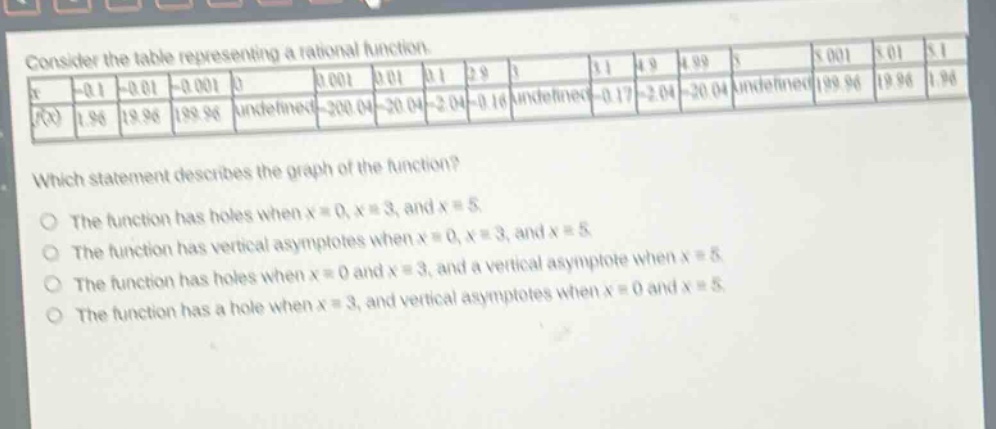
consider the table representing a rational function. which statement describes the graph of the function? the function has holes when x = 0, x = 3, and x = 5. the function has vertical asymptotes when x = 0, x = 3, and x = 5. the function has holes when x = 0 and x = 3, and a vertical asymptote when x = 5. the function has a hole when x = 3, and vertical asymptotes when x = 0 and x = 5. the function has a hole when x = 3, and vertical asymptotes when x = 0 and x = 5.
Answer
Answer:
The function has vertical asymptotes when (x = 0), (x=3), and (x = 5).
Explanation:
Step1: Identify undefined - points
The function is undefined at (x = 0), (x = 3), and (x = 5) as indicated by the "undefined" values in the (y) - column of the table.
Step2: Recall asymptote and hole concepts
A hole in a rational function occurs when a factor in the numerator and denominator cancels out. An asymptote occurs when the denominator of a rational function is zero and the numerator is non - zero. Since there is no information suggesting factor - cancellation, and the function is simply undefined at these points, they are vertical asymptotes.