construct a sinusoid with the given amplitude and period that goes through the given point. amplitude 3…
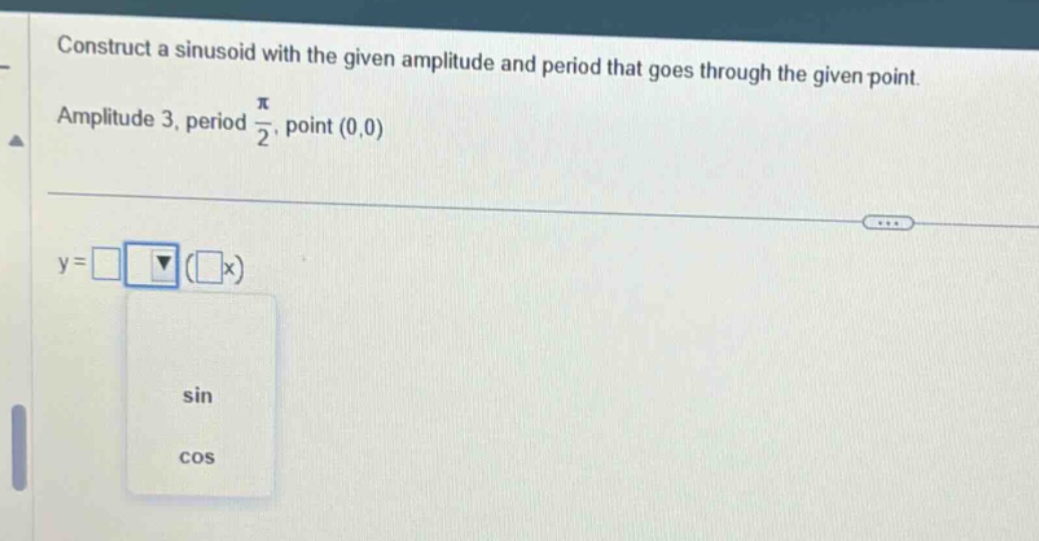
construct a sinusoid with the given amplitude and period that goes through the given point. amplitude 3, period pi/2, point (0,0) y = □ (□x) sin cos
Answer
Explanation:
Step1: Recall the general form of a sinusoid
The general form of a sinusoid is $y = A\sin(Bx - C)+D$ or $y = A\cos(Bx - C)+D$. The amplitude is $|A|$, the period is $T=\frac{2\pi}{|B|}$, the phase - shift is $\frac{C}{B}$, and the vertical shift is $D$. Given that the amplitude $A = 3$, so $|A|=3$. The period $T=\frac{\pi}{2}$.
Step2: Find the value of B
Since $T=\frac{2\pi}{|B|}$ and $T = \frac{\pi}{2}$, we can solve for $B$. Substitute $T$ into the formula: $\frac{\pi}{2}=\frac{2\pi}{|B|}$. Cross - multiply to get $|B|\pi = 4\pi$, then $|B| = 4$.
Step3: Determine the function type and other parameters
The function passes through the point $(0,0)$. If we consider the sine function $y = A\sin(Bx - C)+D$, when $x = 0$, $y=0$. For a sine function with no phase - shift ($C = 0$) and no vertical shift ($D = 0$), substituting $A = 3$ and $B = 4$ gives $y=3\sin(4x)$. If we consider the cosine function $y=A\cos(Bx - C)+D$, when $x = 0$, $y = A\cos(-C)+D$. For $y(0)=0$, with $A = 3$, we would need non - zero values of $C$ and $D$ which is more complicated. Since the sine function $y = 3\sin(4x)$ satisfies the conditions (amplitude 3, period $\frac{\pi}{2}$, and passes through $(0,0)$).
Answer:
$y = 3\sin(4x)$