the continuous function f is decreasing for all x. selected values of f are given in the table above, where…
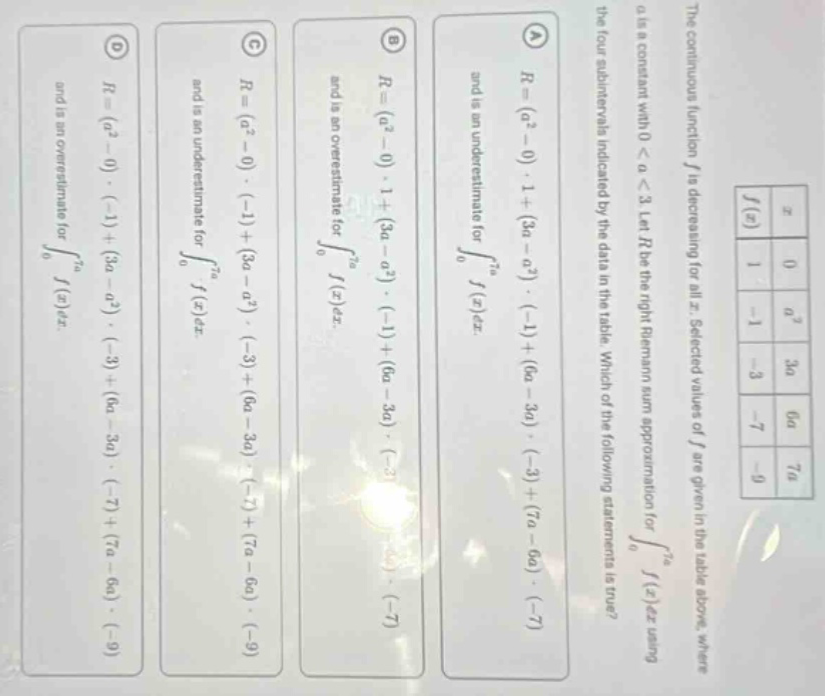
the continuous function f is decreasing for all x. selected values of f are given in the table above, where a is a constant with 0 < a < 3. let r be the right - riemann sum approximation for ∫₀⁻⁹ f(x)dx using the four subintervals indicated by the data in the table. which of the following statements is true? a) r=(a² - 0)·1+(3a - a²)·(-1)+(6a - 3a)·(-3)+(7a - 6a)·(-7) and is an underestimate for ∫₀⁻⁹ f(x)dx. b) r=(a² - 0)·1+(3a - a²)·(-1)+(6a - 3a)·(-3)+(7a - 6a)·(-7) and is an overestimate for ∫₀⁻⁹ f(x)dx. c) r=(a² - 0)·(-1)+(3a - a²)·(-3)+(6a - 3a)·(-7)+(7a - 6a)·(-9) and is an underestimate for ∫₀⁻⁹ f(x)dx. d) r=(a² - 0)·(-1)+(3a - a²)·(-3)+(6a - 3a)·(-7)+(7a - 6a)·(-9) and is an overestimate for ∫₀⁻⁹ f(x)dx.
Answer
Explanation:
Step1: Recall right - Riemann sum formula
The right - Riemann sum for $\int_{0}^{a}f(x)dx$ with $n$ sub - intervals $[x_{i - 1},x_{i}]$ and $\Delta x=\frac{b - a}{n}$ is $R=\sum_{i = 1}^{n}f(x_{i})\Delta x$. Here, the sub - intervals are $[0,a],[a,3a],[3a,6a],[6a,7a],[7a,9a]$, and $\Delta x$ values for the sub - intervals are $a,(3a - a)=2a,(6a - 3a)=3a,(7a - 6a)=a,(9a - 7a)=2a$ respectively. The right - hand endpoints are $a,3a,6a,7a,9a$.
Step2: Calculate the right - Riemann sum
Since $f(x)$ is decreasing, a right - Riemann sum is an underestimate of the integral $\int_{0}^{9a}f(x)dx$. The right - Riemann sum $R=f(a)\cdot a+f(3a)\cdot(3a - a)+f(6a)\cdot(6a - 3a)+f(7a)\cdot(7a - 6a)+f(9a)\cdot(9a - 7a)=(a^{2}-0)\cdot a+(3a - a^{2})\cdot(2a)+(6a - 3a)\cdot(3a)+(7a - 6a)\cdot a+(9a - 7a)\cdot(2a)=(a^{2}-0)\cdot a+(3a - a^{2})\cdot(2a)+(6a - 3a)\cdot(3a)+(7a - 6a)\cdot a+(9a - 7a)\cdot(2a)$
Answer:
B. $R=(a^{2}-0)\cdot a+(3a - a^{2})\cdot(2a)+(6a - 3a)\cdot(3a)+(7a - 6a)\cdot a+(9a - 7a)\cdot(2a)$ and is an underestimate for $\int_{0}^{9a}f(x)dx$