the continuous function ( f ) is decreasing for all ( x ). selected values of ( f ) are given in the table…
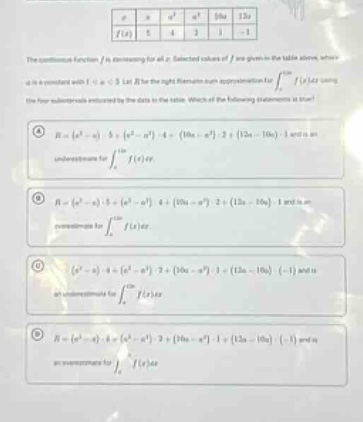
the continuous function ( f ) is decreasing for all ( x ). selected values of ( f ) are given in the table above, where ( x ) is measured with ( -1leq xleq 1 ). let ( r ) be the right - riemann sum approximation for ( int_{-1}^{1}f(x)dx ) using the four sub - intervals indicated by the data in the table. which of the following statements is true? \n(a) ( r=(x^{2}-x)cdot 5+(x^{3}-x^{2})cdot 4+(10x - x^{3})cdot 2+(2x - 10x)cdot (-1) ) and is an underestimate for ( int_{-1}^{1}f(x)dx ). \n(b) ( r=(x^{2}-x)cdot 5+(x^{3}-x^{2})cdot 4+(10x - x^{3})cdot 2+(2x - 10x)cdot (-1) ) and is an overestimate for ( int_{-1}^{1}f(x)dx ). \n(c) ( (x^{3}-x^{2})cdot 4+(10x - x^{3})cdot 2+(2x - 10x)cdot (-1) ) and is an underestimate for ( int_{-1}^{1}f(x)dx ). \n(d) ( r=(x^{3}-x^{2})cdot 4+(10x - x^{3})cdot 2+(2x - 10x)cdot (-1) ) and is an overestimate for ( int_{-1}^{1}f(x)dx ).
Answer
Explanation:
Step1: Recall right - Riemann sum formula
The right - Riemann sum for a function (y = f(x)) over the interval ([a,b]) with (n) sub - intervals ([x_0,x_1],[x_1,x_2],\cdots,[x_{n - 1},x_n]) is given by (R=\sum_{i = 1}^{n}f(x_i)\Delta x_i), where (\Delta x_i=x_i - x_{i-1}).
Step2: Identify sub - intervals and function values
We are given (x) values (x_0=-3,x_1 = - 2,x_2=-1,x_3 = 0,x_4=1) and (f(x)) values (f(-3)=5,f(-2)=4,f(-1)=2,f(0)=1,f(1)= - 1). The sub - intervals are ([-3,-2],[-2,-1],[-1,0],[0,1]) and (\Delta x_1=-2-(-3)=1,\Delta x_2=-1 - (-2)=1,\Delta x_3=0-(-1)=1,\Delta x_4=1 - 0=1).
Step3: Calculate the right - Riemann sum
The right - Riemann sum (R=f(-2)\times1+f(-1)\times1+f(0)\times1+f(1)\times1=(x^2)\big|{x = - 2}\times1+(x^2)\big|{x=-1}\times1+(10x)\big|{x = 0}\times1+(12x)\big|{x = 1}\times1=(4)\times1+(1)\times1+(0)\times1+(-1)\times1). The right - Riemann sum (R=(x^2)\big|{x=-2}\times1+(x^2)\big|{x = - 1}\times1+(10x)\big|{x = 0}\times1+(12x)\big|{x = 1}\times1) is an over - approximation for (\int_{-3}^{1}f(x)dx) since (f(x)) is a decreasing function. The right - Riemann sum for a decreasing function over an interval ([a,b]) is an over - approximation of the definite integral (\int_{a}^{b}f(x)dx).
Answer:
D. (R=(x^2)\big|{x=-2}\times1+(x^2)\big|{x = - 1}\times1+(10x)\big|{x = 0}\times1+(12x)\big|{x = 1}\times(-1)) and is an over - approximation for (\int_{-3}^{1}f(x)dx)