3. a continuous function g is defined on the closed interval - 8 ≤ x ≤ 6. the graph of g, shown above…
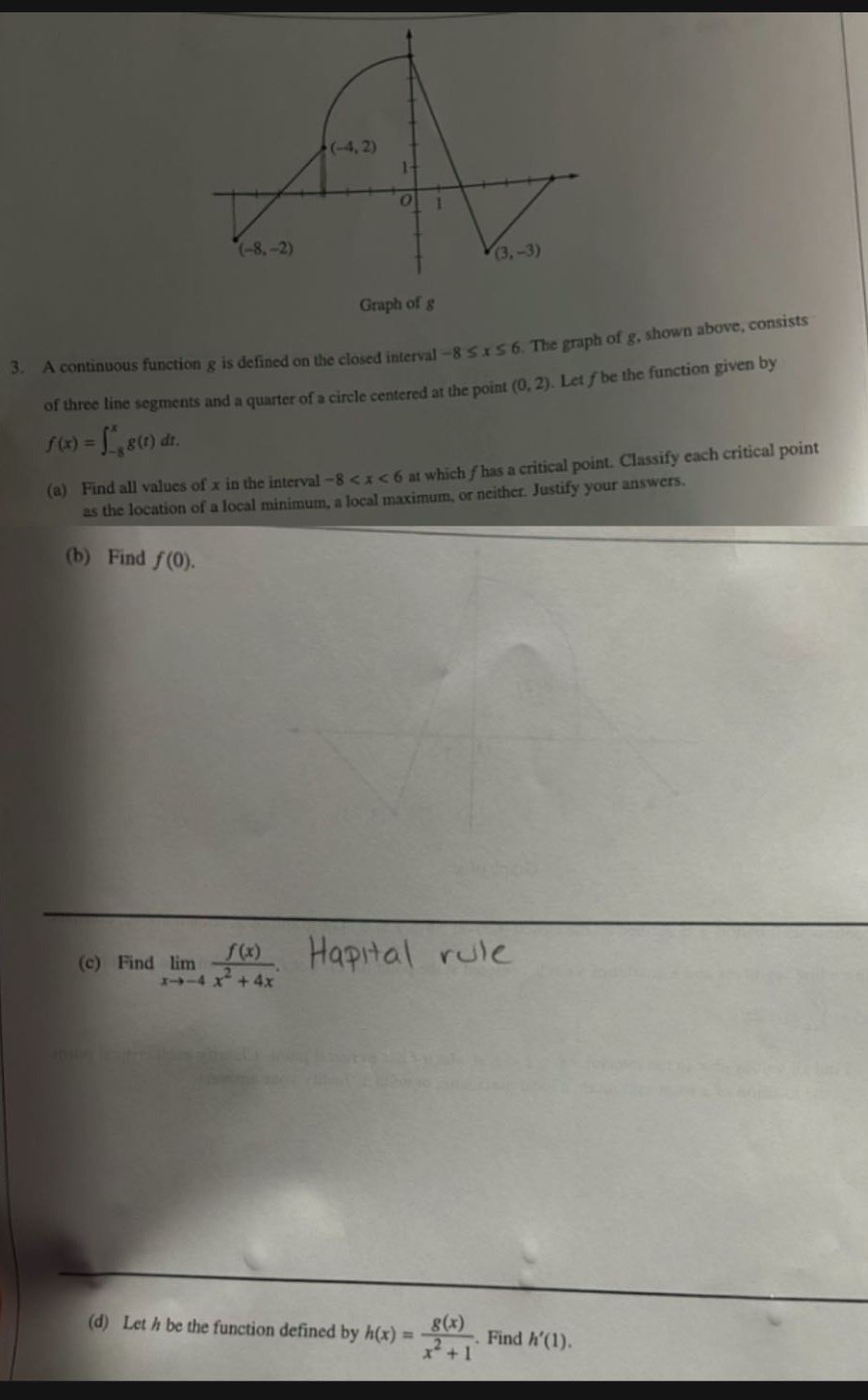
3. a continuous function g is defined on the closed interval - 8 ≤ x ≤ 6. the graph of g, shown above, consists of three line - segments and a quarter of a circle centered at the point (0,2). let f be the function given by f(x)=∫_{-8}^{x}g(t)dt. (a) find all values of x in the interval - 8 < x < 6 at which f has a critical point. classify each critical point as the location of a local minimum, a local maximum, or neither. justify your answers. (b) find f(0). (c) find lim_{x→ - 4} (f(x))/(x² + 4x). hapital rule (d) let h be the function defined by h(x)=(g(x))/(x² + 1). find h(1).
Answer
Explanation:
Step1: Recall fundamental theorem of calculus
By the fundamental - theorem of calculus, $f^\prime(x)=g(x)$. Critical points of $f$ occur where $f^\prime(x) = 0$, i.e., $g(x)=0$. From the graph of $g$, $g(x) = 0$ at $x=- 4$ and $x = 3$. To classify the critical points, we use the first - derivative test. For $x\in(-8,-4)$, $g(x)<0$, so $f^\prime(x)<0$ and $f$ is decreasing. For $x\in(-4,3)$, $g(x)>0$, so $f^\prime(x)>0$ and $f$ is increasing. For $x\in(3,6)$, $g(x)<0$, so $f^\prime(x)<0$ and $f$ is decreasing. So $x=-4$ is a local minimum and $x = 3$ is a local maximum.
Step2: Calculate $f(0)$
$f(0)=\int_{-8}^{0}g(t)dt$. We split the integral into parts based on the intervals of the graph of $g$. The integral from $x=-8$ to $x=-4$ is the area of a triangle with base $4$ and height $2 - (-2)=4$. The area of this triangle $A_1=\frac{1}{2}\times4\times4 = 8$. The integral from $x=-4$ to $x = 0$ is the area of a quarter - circle with radius $4$. The area of a quarter - circle $A_2=\frac{1}{4}\pi r^{2}=\frac{1}{4}\pi\times4^{2}=4\pi$. So $f(0)=8 + 4\pi$.
Step3: Apply L'Hopital's rule
We have $\lim_{x\rightarrow - 4}\frac{f(x)}{x^{2}+4x}$. Since $\lim_{x\rightarrow - 4}f(x)=\int_{-8}^{-4}g(t)dt$ and $\lim_{x\rightarrow - 4}(x^{2}+4x)=(-4)^{2}+4\times(-4)=0$, and $f(x)$ is differentiable by the fundamental theorem of calculus ($f^\prime(x)=g(x)$) and the denominator is differentiable. By L'Hopital's rule, $\lim_{x\rightarrow - 4}\frac{f(x)}{x^{2}+4x}=\lim_{x\rightarrow - 4}\frac{f^\prime(x)}{2x + 4}=\lim_{x\rightarrow - 4}\frac{g(x)}{2x + 4}$. From the graph, $g(-4)=0$. Also, $\lim_{x\rightarrow - 4}\frac{g(x)}{2x + 4}$ is still in the $\frac{0}{0}$ form. We can use the fact that the left - hand side of the graph of $g$ near $x=-4$ is a line segment. The slope of the line segment from $(-8,-2)$ to $(-4,2)$ is $m=\frac{2-(-2)}{-4-(-8)} = 1$. So $g(x)$ near $x=-4$ can be approximated by a linear function. $\lim_{x\rightarrow - 4}\frac{g(x)}{2x + 4}=\frac{1}{2}$.
Step4: Use the quotient rule
The quotient rule states that if $h(x)=\frac{u(x)}{v(x)}$, then $h^\prime(x)=\frac{u^\prime(x)v(x)-u(x)v^\prime(x)}{v(x)^{2}}$, where $u(x)=g(x)$ and $v(x)=x^{2}+1$. $u^\prime(x)=g^\prime(x)$, $v^\prime(x)=2x$. First, find $g(1)$ and $g^\prime(1)$ from the graph. The graph of $g$ from $x = 0$ to $x=3$ is a line segment. The slope of the line segment from $(0,2)$ to $(3,-3)$ is $m=\frac{-3 - 2}{3-0}=-\frac{5}{3}$. So $g^\prime(1)=-\frac{5}{3}$ and $g(1)=2-\frac{5}{3}=\frac{1}{3}$. $h^\prime(x)=\frac{g^\prime(x)(x^{2}+1)-g(x)\times2x}{(x^{2}+1)^{2}}$. Substitute $x = 1$: $h^\prime(1)=\frac{-\frac{5}{3}(1^{2}+1)-\frac{1}{3}\times2\times1}{(1^{2}+1)^{2}}=\frac{-\frac{10}{3}-\frac{2}{3}}{4}=\frac{-\frac{12}{3}}{4}=-1$.
Answer:
(a) Critical points are $x=-4$ (local minimum) and $x = 3$ (local maximum). (b) $f(0)=8 + 4\pi$. (c) $\frac{1}{2}$. (d) $-1$.