6. if f is a continuous function for all real x, then lim h→0 1/h ∫a^a+h f(x) dx is (a) 0 (b) f(0) (c) f(a)…
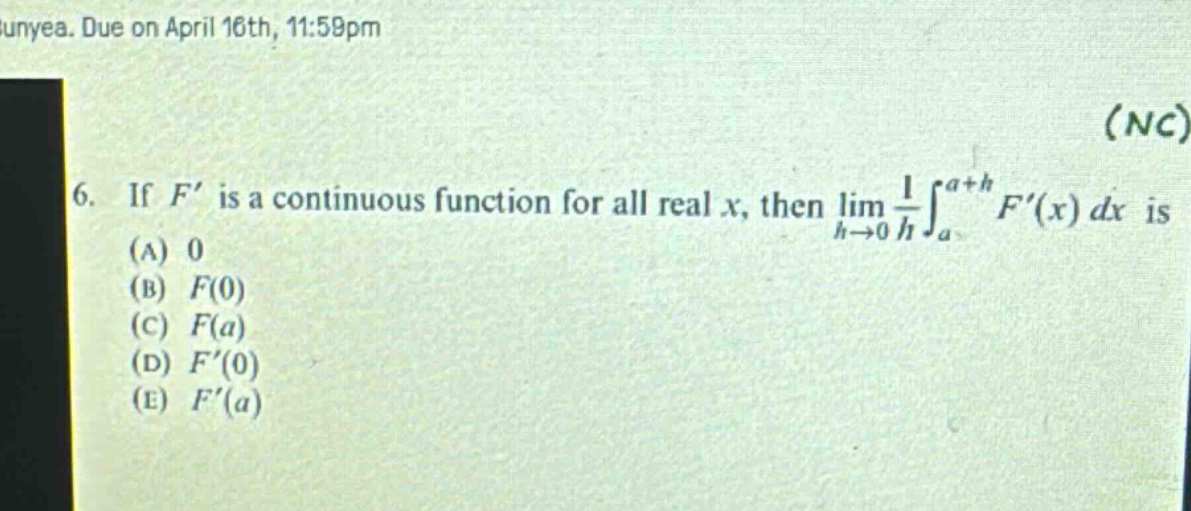
6. if f is a continuous function for all real x, then lim h→0 1/h ∫a^a+h f(x) dx is (a) 0 (b) f(0) (c) f(a) (d) f(0) (e) f(a)
Answer
Explanation:
Step1: Apply fundamental theorem of calculus
By the fundamental theorem of calculus, $\int_{a}^{a + h}F'(x)dx=F(a + h)-F(a)$. So the limit becomes $\lim_{h\rightarrow0}\frac{F(a + h)-F(a)}{h}$.
Step2: Recall the definition of the derivative
The definition of the derivative of a function $y = F(x)$ at $x=a$ is $F'(a)=\lim_{h\rightarrow0}\frac{F(a + h)-F(a)}{h}$.
Answer:
E. $F'(a)$