p(1, 0) corresponds to on the sine graph. done p(0, 1) corresponds to on the sine graph. done p(-1, 0)…
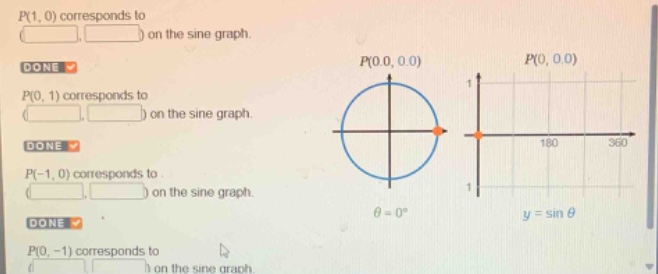
p(1, 0) corresponds to on the sine graph. done p(0, 1) corresponds to on the sine graph. done p(-1, 0) corresponds to on the sine graph. done p(0, -1) corresponds to on the sine graph.
Answer
Explanation:
Step1: Recall sine - graph properties
The general form of a point on the unit - circle is $(\cos\theta,\sin\theta)$. For the sine function $y = \sin\theta$.
Step2: Analyze $P(1,0)$
If $x = 1$ and $y = 0$ on the unit - circle, then $\cos\theta=1$ and $\sin\theta = 0$. This occurs when $\theta = 0^{\circ}$ or $0$ radians. On the sine graph $y=\sin\theta$, when $\theta = 0$, $y = 0$. So $P(1,0)$ corresponds to $(0,0)$ on the sine graph.
Step3: Analyze $P(0,1)$
If $x = 0$ and $y = 1$ on the unit - circle, then $\cos\theta=0$ and $\sin\theta = 1$. This occurs when $\theta = 90^{\circ}$ or $\frac{\pi}{2}$ radians. On the sine graph $y = \sin\theta$, when $\theta=\frac{\pi}{2}$, $y = 1$. So $P(0,1)$ corresponds to $(\frac{\pi}{2},1)$ on the sine graph.
Step4: Analyze $P(-1,0)$
If $x=-1$ and $y = 0$ on the unit - circle, then $\cos\theta=-1$ and $\sin\theta = 0$. This occurs when $\theta = 180^{\circ}$ or $\pi$ radians. On the sine graph $y=\sin\theta$, when $\theta=\pi$, $y = 0$. So $P(-1,0)$ corresponds to $(\pi,0)$ on the sine graph.
Step5: Analyze $P(0, - 1)$
If $x = 0$ and $y=-1$ on the unit - circle, then $\cos\theta=0$ and $\sin\theta=-1$. This occurs when $\theta = 270^{\circ}$ or $\frac{3\pi}{2}$ radians. On the sine graph $y=\sin\theta$, when $\theta=\frac{3\pi}{2}$, $y=-1$. So $P(0,-1)$ corresponds to $(\frac{3\pi}{2},-1)$ on the sine graph.
Answer:
$P(1,0)$ corresponds to $(0,0)$ on the sine graph. $P(0,1)$ corresponds to $(\frac{\pi}{2},1)$ on the sine graph. $P(-1,0)$ corresponds to $(\pi,0)$ on the sine graph. $P(0,-1)$ corresponds to $(\frac{3\pi}{2},-1)$ on the sine graph.