cos(θ)=√2/2,and 3π/2<θ<2π, evaluate sin(θ) and tan(θ). sin(θ)=? -√2 -√2/2 √2/2 √2 tan(θ)= done
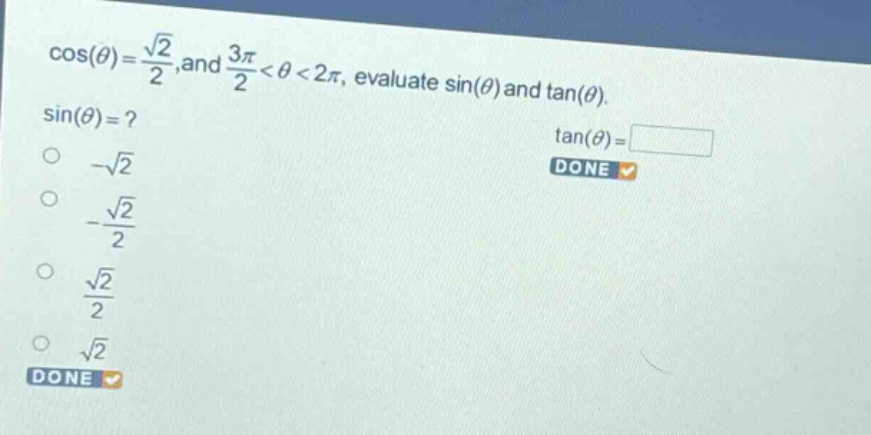
cos(θ)=√2/2,and 3π/2<θ<2π, evaluate sin(θ) and tan(θ). sin(θ)=? -√2 -√2/2 √2/2 √2 tan(θ)= done
Answer
Explanation:
Step1: Use the Pythagorean identity
We know that $\sin^{2}\theta+\cos^{2}\theta = 1$. Given $\cos\theta=\frac{\sqrt{2}}{2}$, then $\sin^{2}\theta=1 - \cos^{2}\theta$. Substitute $\cos\theta$: $\sin^{2}\theta=1-(\frac{\sqrt{2}}{2})^{2}=1-\frac{2}{4}=\frac{2}{4}=\frac{1}{2}$, so $\sin\theta=\pm\frac{\sqrt{2}}{2}$.
Step2: Determine the sign of $\sin\theta$
Since $\frac{3\pi}{2}<\theta<2\pi$, $\theta$ is in the fourth - quadrant. In the fourth - quadrant, $\sin\theta<0$. So $\sin\theta =-\frac{\sqrt{2}}{2}$.
Step3: Calculate $\tan\theta$
We know that $\tan\theta=\frac{\sin\theta}{\cos\theta}$. Substitute $\sin\theta =-\frac{\sqrt{2}}{2}$ and $\cos\theta=\frac{\sqrt{2}}{2}$ into the formula: $\tan\theta=\frac{-\frac{\sqrt{2}}{2}}{\frac{\sqrt{2}}{2}}=- 1$.
Answer:
$\sin(\theta)=-\frac{\sqrt{2}}{2}$, $\tan(\theta)=-1$