if cos(x) = 4/5 and (x) is in quadrant iv, find: sin(2x) = cos(2x) = tan(2x) = the angle represented by 2x…
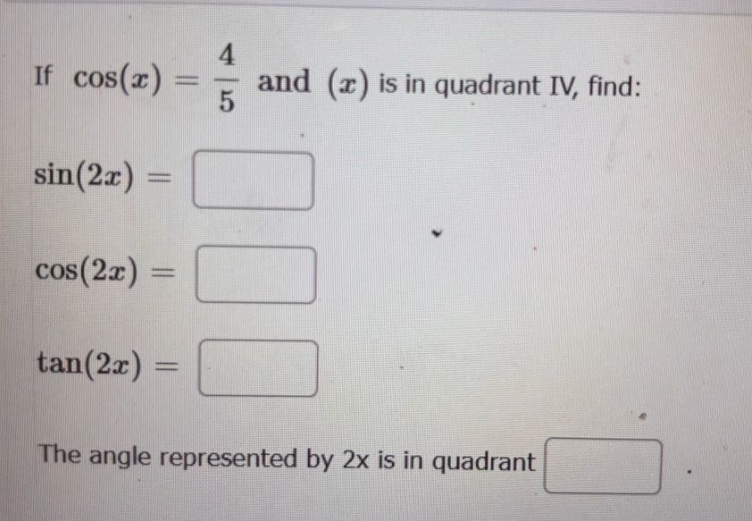
if cos(x) = 4/5 and (x) is in quadrant iv, find: sin(2x) = cos(2x) = tan(2x) = the angle represented by 2x is in quadrant
Answer
Explanation:
Step1: Find sin(x)
Since $\sin^{2}x+\cos^{2}x = 1$, then $\sin x=\pm\sqrt{1 - \cos^{2}x}$. Given $\cos x=\frac{4}{5}$ and $x$ is in quadrant IV where $\sin x<0$, so $\sin x=-\sqrt{1 - (\frac{4}{5})^{2}}=-\sqrt{1-\frac{16}{25}}=-\sqrt{\frac{9}{25}}=-\frac{3}{5}$.
Step2: Find sin(2x)
Use the double - angle formula $\sin(2x)=2\sin x\cos x$. Substitute $\sin x = -\frac{3}{5}$ and $\cos x=\frac{4}{5}$, we get $\sin(2x)=2\times(-\frac{3}{5})\times\frac{4}{5}=-\frac{24}{25}$.
Step3: Find cos(2x)
Use the double - angle formula $\cos(2x)=\cos^{2}x-\sin^{2}x$. Substitute $\sin x = -\frac{3}{5}$ and $\cos x=\frac{4}{5}$, we have $\cos(2x)=(\frac{4}{5})^{2}-(-\frac{3}{5})^{2}=\frac{16}{25}-\frac{9}{25}=\frac{7}{25}$.
Step4: Find tan(2x)
Use the formula $\tan(2x)=\frac{\sin(2x)}{\cos(2x)}$. Substitute $\sin(2x)=-\frac{24}{25}$ and $\cos(2x)=\frac{7}{25}$, we obtain $\tan(2x)=\frac{-\frac{24}{25}}{\frac{7}{25}}=-\frac{24}{7}$.
Step5: Determine the quadrant of 2x
Since $\sin(2x)<0$ and $\cos(2x)>0$, the angle $2x$ is in quadrant IV.
Answer:
$\sin(2x)=-\frac{24}{25}$ $\cos(2x)=\frac{7}{25}$ $\tan(2x)=-\frac{24}{7}$ The angle represented by $2x$ is in quadrant IV.