what is the cosine equation of the function shown? enter your answer by filling in the boxes. enter any…
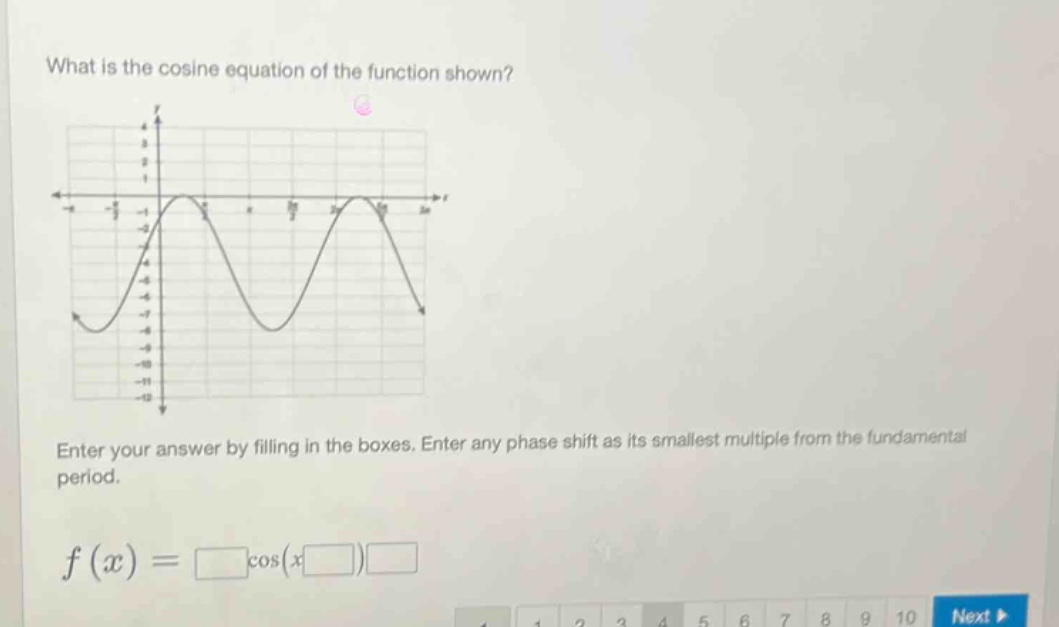
what is the cosine equation of the function shown? enter your answer by filling in the boxes. enter any phase shift as its smallest multiple from the fundamental period. $f(x)=squarecos(xsquare)square$
Answer
Explanation:
Step1: Determine the amplitude
The amplitude $A$ of a cosine - function $y = A\cos(Bx - C)+D$ is half the distance between the maximum and minimum values of the function. From the graph, the maximum value is $y = 4$ and the minimum value is $y=-4$. So, $A=\frac{4 - (-4)}{2}=4$.
Step2: Determine the period and the value of $B$
The standard period of the cosine function $y = \cos(x)$ is $2\pi$. For the function $y=\cos(Bx)$, the period $T=\frac{2\pi}{B}$. From the graph, the period $T = 4\pi$. So, $\frac{2\pi}{B}=4\pi$. Solving for $B$, we get $B=\frac{1}{2}$.
Step3: Determine the phase - shift and vertical - shift
The graph of $y = \cos(x)$ has a maximum at $x = 0$. The given cosine - function has a maximum at $x = 0$, so the phase - shift $C = 0$. Also, the mid - line of the function is $y = 0$, so the vertical - shift $D = 0$.
Answer:
$f(x)=4\cos(\frac{1}{2}x)+0$ or simply $f(x)=4\cos(\frac{1}{2}x)$