cosine: vertical part 7 of 7 question completed: 11 of 13 my score: 9.2/13 pts (70.76%) the graph to the…
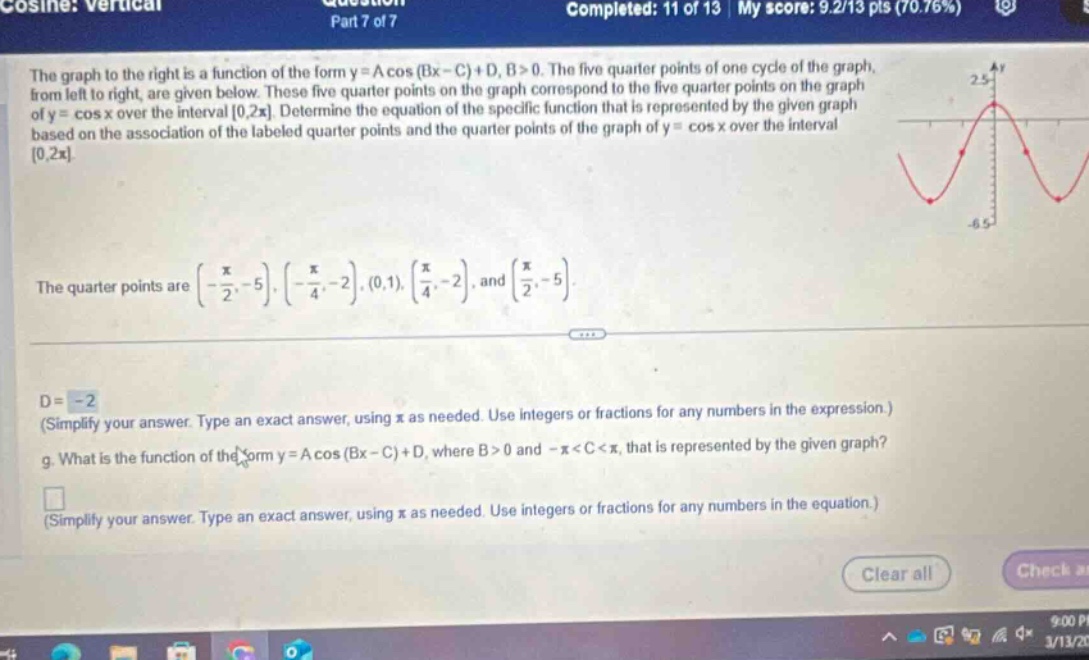
cosine: vertical part 7 of 7 question completed: 11 of 13 my score: 9.2/13 pts (70.76%) the graph to the right is a function of the form y = a cos (bx - c)+d, b>0. the five - quarter points of one cycle of the graph, from left to right, are given below. these five - quarter points on the graph correspond to the five - quarter points on the graph of y = cos x over the interval 0,2π. determine the equation of the specific function that is represented by the given graph based on the association of the labeled quarter points and the quarter points of the graph of y = cos x over the interval 0,2π. the quarter points are (-π/2,-5),(-π/4,-2),(0,1),(π/4,-2), and (π/2,-5). d = - 2 (simplify your answer. type an exact answer, using π as needed. use integers or fractions for any numbers in the expression.) g. what is the function of the form y = a cos (bx - c)+d, where b>0 and -π<c<π, that is represented by the given graph? (simplify your answer. type an exact answer, using π as needed. use integers or fractions for any numbers in the equation.)
Answer
Explanation:
Step1: Find the amplitude A
The amplitude is half the vertical distance between the maximum and minimum values. The maximum value is 1 and the minimum value is - 5. So, $A=\frac{1 - (-5)}{2}=\frac{6}{2}=3$.
Step2: Find the period P
The distance between two consecutive quarter - points gives information about the period. The distance between $x =-\frac{\pi}{2}$ and $x=\frac{\pi}{2}$ is $\pi$. Since this is half of a period for a cosine - type function, the period $P=\pi$. Using the formula $P=\frac{2\pi}{B}$, and since $P = \pi$, we have $\pi=\frac{2\pi}{B}$, so $B = 2$.
Step3: Find the phase - shift C
The general form of the cosine function is $y=A\cos(Bx - C)+D$. We know that for the standard cosine function $y = \cos x$, the maximum occurs at $x = 0$. For our function $y=A\cos(Bx - C)+D$, when $x = 0$, $y = 1$. Substituting $A = 3$, $B = 2$, $D=-2$ into $y=A\cos(Bx - C)+D$, we get $1=3\cos(-C)-2$. Then $3\cos(-C)=3$, so $\cos(-C)=1$. Since $-\pi<C<\pi$, then $C = 0$.
Answer:
$y = 3\cos(2x)-2$