cosine: vertical\nquestion\npart 7 of 7\ncompleted: 11 of 13 my score: 9.2/13 pts (70.76%)\nthe graph to the…
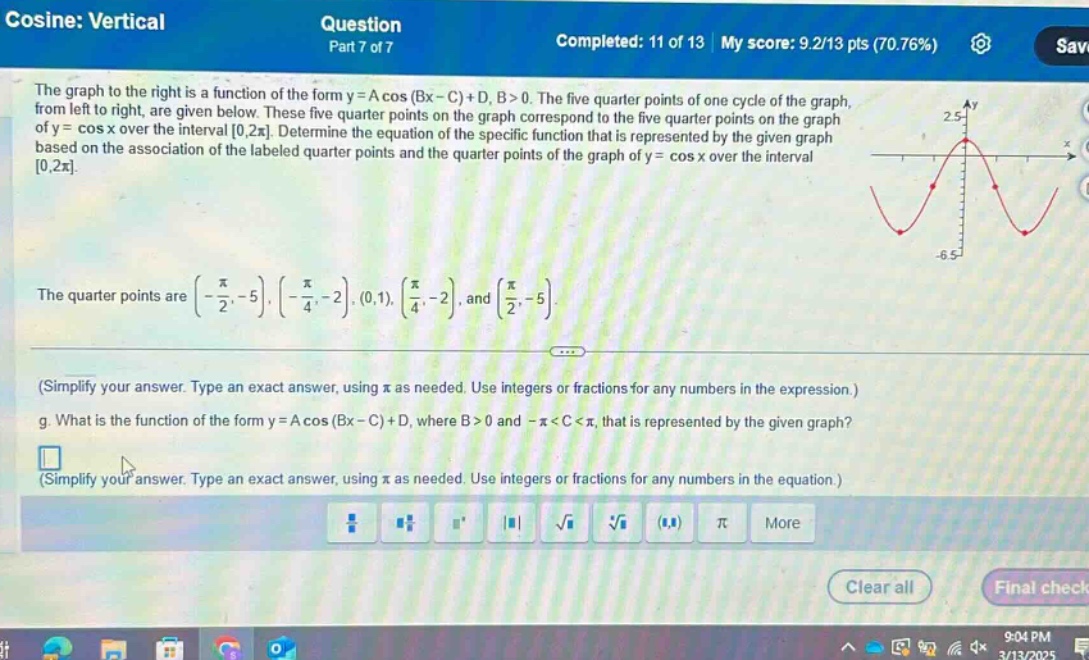
cosine: vertical\nquestion\npart 7 of 7\ncompleted: 11 of 13 my score: 9.2/13 pts (70.76%)\nthe graph to the right is a function of the form y = a cos (bx - c)+d, b > 0. the five quarter - points of one cycle of the graph, from left to right, are given below. these five quarter - points on the graph correspond to the five quarter - points on the graph of y = cos x over the interval 0,2π. determine the equation of the specific function that is represented by the given graph based on the association of the labeled quarter - points and the quarter - points of the graph of y = cos x over the interval 0,2π.\nthe quarter points are (-π/2,-5), (-π/4,-2), (0,1), (π/4,-2), and (π/2,-5).\n(simplify your answer. type an exact answer, using π as needed. use integers or fractions for any numbers in the expression.)\nwhat is the function of the form y = a cos (bx - c)+d, where b > 0 and -π < c < π, that is represented by the given graph?\n(simplify your answer. type an exact answer, using π as needed. use integers or fractions for any numbers in the equation.)
Answer
Explanation:
Step1: Find the amplitude A
The amplitude is half the vertical distance between the maximum and minimum values. The maximum value is 2.5 and the minimum is - 6.5. So, $A=\frac{2.5-(-6.5)}{2}=\frac{2.5 + 6.5}{2}=\frac{9}{2}=4.5$.
Step2: Find the vertical - shift D
The vertical - shift D is the average of the maximum and minimum values. So, $D=\frac{2.5+( - 6.5)}{2}=\frac{2.5-6.5}{2}=\frac{-4}{2}=-2$.
Step3: Find the period P
The distance between two consecutive quarter - points gives information about the period. The difference between $x$ - values of two consecutive quarter - points: for example, from $x =-\frac{\pi}{2}$ to $x=-\frac{\pi}{4}$, the increment is $\frac{\pi}{4}$. Since the distance between two consecutive quarter - points is $\frac{P}{4}$, and if we consider the full cycle, the period $P = 2\pi$. For the general cosine function $y = A\cos(Bx - C)+D$, the period formula is $P=\frac{2\pi}{B}$. Since $P = 2\pi$, then $B = 1$.
Step4: Find the phase - shift C
The general form of the cosine function is $y=A\cos(Bx - C)+D$. When $x = 0$, $y = 0.1$. Substitute $A = 4.5$, $B = 1$, $D=-2$ into $y=A\cos(Bx - C)+D$: $0.1=4.5\cos(0 - C)-2$. First, add 2 to both sides: $0.1 + 2=4.5\cos(-C)$. $2.1 = 4.5\cos C$ (since $\cos(-\theta)=\cos\theta$). Then, $\cos C=\frac{2.1}{4.5}=\frac{7}{15}$. $C=\arccos(\frac{7}{15})\approx1.0808$. Since $-\pi<C<\pi$, we keep this value.
Answer:
$y = 4.5\cos(x-\arccos(\frac{7}{15}))-2$