if cosx = 2/3 and x is in quadrant 4, then sin(x/2) = ______. a. -1/3 b. √(1/6) c. 1/3 d. -√(1/6)
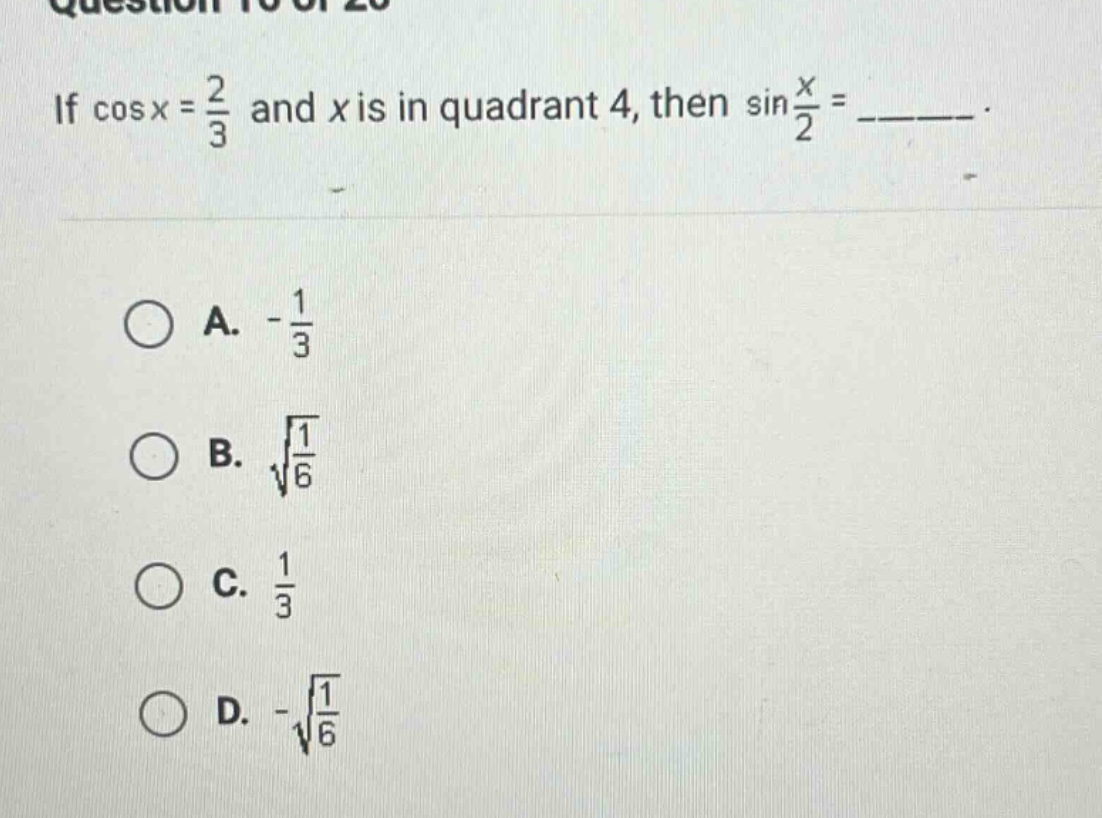
if cosx = 2/3 and x is in quadrant 4, then sin(x/2) = ______. a. -1/3 b. √(1/6) c. 1/3 d. -√(1/6)
Answer
Answer:
D. $-\sqrt{\frac{1}{6}}$
Explanation:
Step1: Recall half - angle formula
$\sin\frac{x}{2}=\pm\sqrt{\frac{1 - \cos x}{2}}$
Step2: Determine the sign
Since $x$ is in quadrant 4, $270^{\circ}+ 360^{\circ}n<x<360^{\circ}+ 360^{\circ}n$, $n\in\mathbb{Z}$. Then $135^{\circ}+ 180^{\circ}n<\frac{x}{2}<180^{\circ}+ 180^{\circ}n$. When considering the principal values, $\frac{x}{2}$ is in quadrant 2 or 4. The sine function is negative in the fourth - quadrant values of $\frac{x}{2}$, so we take the negative root.
Step3: Substitute $\cos x$ value
Given $\cos x=\frac{2}{3}$, substitute into the formula: $\sin\frac{x}{2}=-\sqrt{\frac{1-\frac{2}{3}}{2}}=-\sqrt{\frac{\frac{1}{3}}{2}}=-\sqrt{\frac{1}{6}}$