o y = cot(x)-2\no y = tan(x)-2\no y = cot(x)+2\no y = tan(x)+2
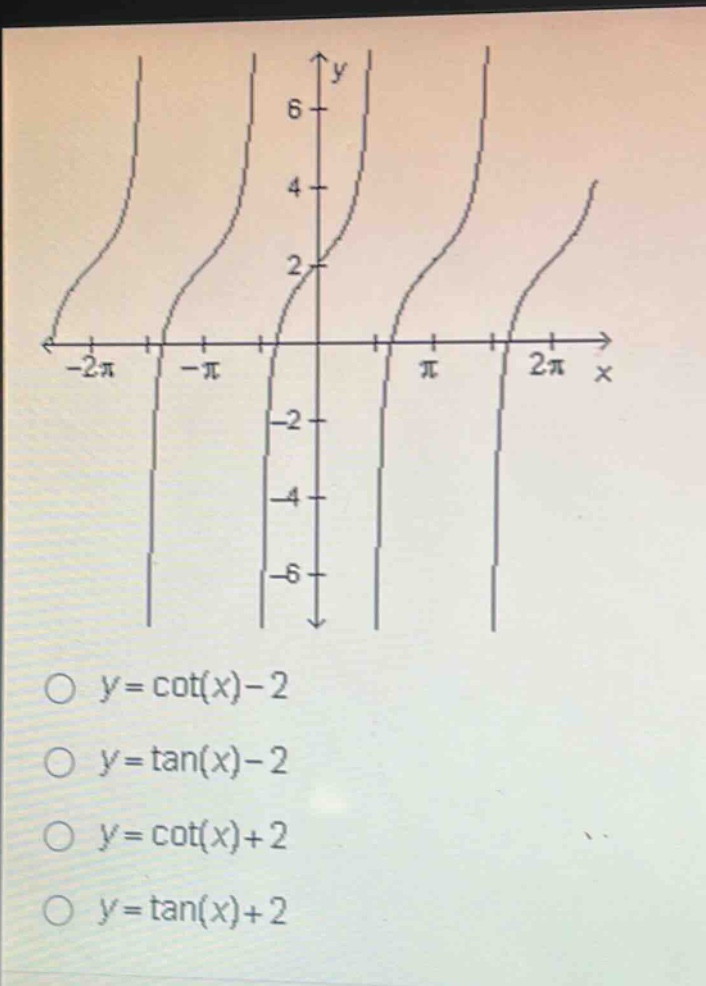
o y = cot(x)-2\no y = tan(x)-2\no y = cot(x)+2\no y = tan(x)+2
Answer
Explanation:
Step1: Recall properties of tangent and cotangent functions
The cotangent function (y = \cot(x)=\frac{\cos(x)}{\sin(x)}) has vertical - asymptotes at (x = n\pi), where (n\in\mathbb{Z}), and the tangent function (y=\tan(x)=\frac{\sin(x)}{\cos(x)}) has vertical - asymptotes at (x=(n +\frac{1}{2})\pi), where (n\in\mathbb{Z}). The given graph has vertical asymptotes at (x = n\pi), so it is a transformation of the cotangent function.
Step2: Analyze the vertical shift
The standard cotangent function (y = \cot(x)) has a (y) - intercept of (y=\cot(0)) which is undefined. The graph of the given function intersects the (y) - axis at (y = 2). The general form of a vertical shift of a function (y = f(x)) is (y=f(x)+k), where (k) is the vertical shift. For the cotangent function (y=\cot(x)), when we shift it up by 2 units, we get (y=\cot(x)+2).
Answer:
(y = \cot(x)+2)