create a table of values and graph the function over the period.\n7.) you can model the deer population in a…
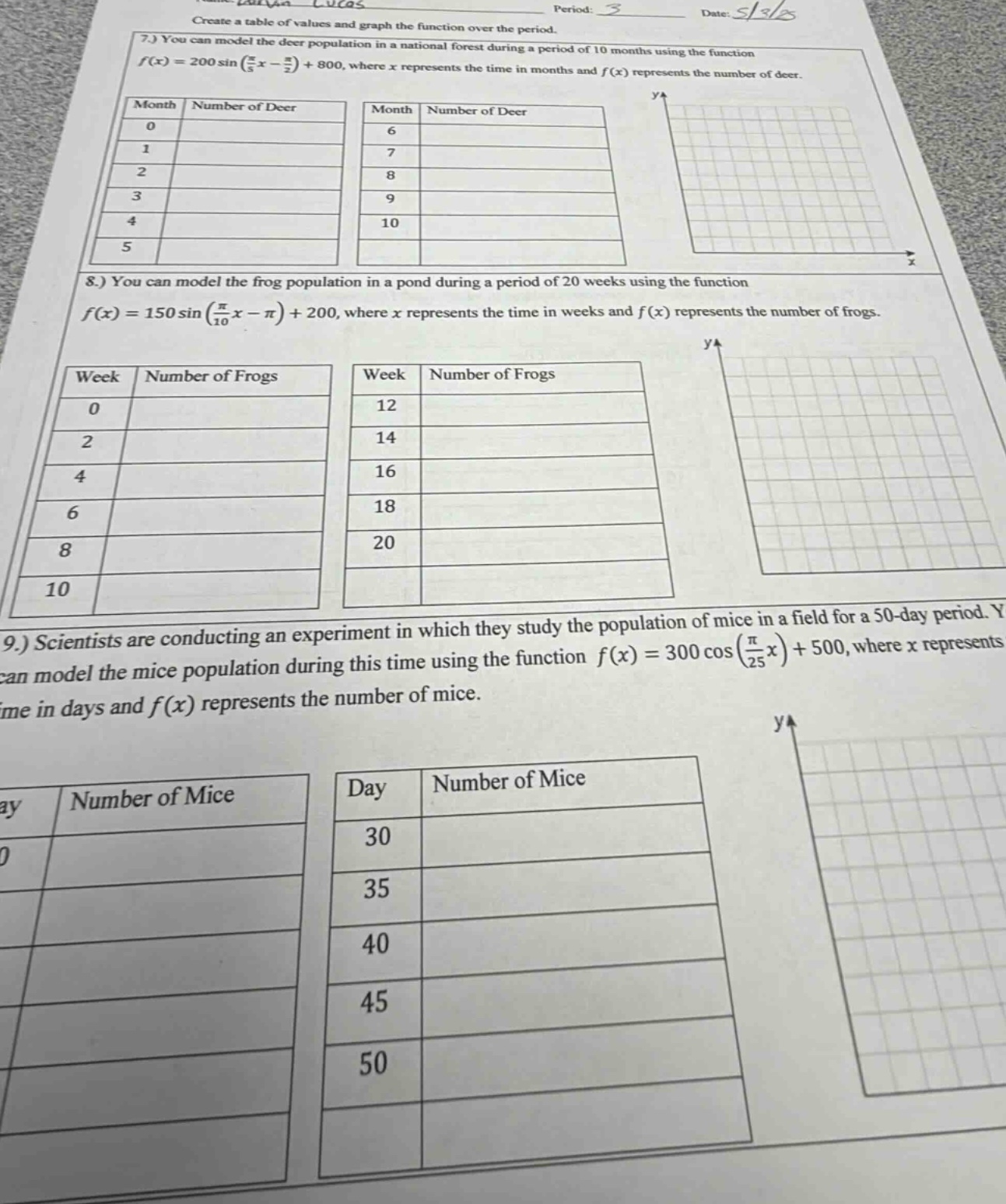
create a table of values and graph the function over the period.\n7.) you can model the deer population in a national forest during a period of 10 months using the function (f(x)=200sin(\frac{pi}{5}x - \frac{pi}{2})+800), where (x) represents the time in months and (f(x)) represents the number of deer.\n8.) you can model the frog population in a pond during a period of 20 weeks using the function (f(x)=150sin(\frac{pi}{10}x-pi)+200), where (x) represents the time in weeks and (f(x)) represents the number of frogs.\n9.) scientists are conducting an experiment in which they study the population of mice in a field for a 50 - day period. you can model the mice population during this time using the function (f(x)=300cos(\frac{pi}{25}x)+500), where (x) represents the time in days and (f(x)) represents the number of mice.
Answer
Explanation:
Paso 1: Calcular valores para la población de ciervos
Para la función $f(x)=200\sin(\frac{\pi}{5}x - \frac{\pi}{2})+800$, evaluamos para $x = 0,1,\cdots,10$.
- Cuando $x = 0$: $f(0)=200\sin(-\frac{\pi}{2})+800=200\times(- 1)+800=600$
- Cuando $x = 1$: $f(1)=200\sin(\frac{\pi}{5}-\frac{\pi}{2})+800=200\sin(-\frac{3\pi}{10})+800\approx200\times(-0.809)+800 = 638.2$
- Cuando $x = 2$: $f(2)=200\sin(\frac{2\pi}{5}-\frac{\pi}{2})+800=200\sin(-\frac{\pi}{10})+800\approx200\times(-0.309)+800 = 738.2$
- Cuando $x = 3$: $f(3)=200\sin(\frac{3\pi}{5}-\frac{\pi}{2})+800=200\sin(\frac{\pi}{10})+800\approx200\times0.309 + 800=861.8$
- Cuando $x = 4$: $f(4)=200\sin(\frac{4\pi}{5}-\frac{\pi}{2})+800=200\sin(\frac{3\pi}{10})+800\approx200\times0.809+800 = 961.8$
- Cuando $x = 5$: $f(5)=200\sin(\pi-\frac{\pi}{2})+800=200\sin(\frac{\pi}{2})+800=200\times1 + 800=1000$
- Cuando $x = 6$: $f(6)=200\sin(\frac{6\pi}{5}-\frac{\pi}{2})+800=200\sin(\frac{7\pi}{10})+800\approx200\times0.951+800 = 990.2$
- Cuando $x = 7$: $f(7)=200\sin(\frac{7\pi}{5}-\frac{\pi}{2})+800=200\sin(\frac{9\pi}{10})+800\approx200\times0.951+800 = 990.2$
- Cuando $x = 8$: $f(8)=200\sin(\frac{8\pi}{5}-\frac{\pi}{2})+800=200\sin(\frac{11\pi}{10})+800\approx200\times(-0.309)+800 = 738.2$
- Cuando $x = 9$: $f(9)=200\sin(\frac{9\pi}{5}-\frac{\pi}{2})+800=200\sin(\frac{13\pi}{10})+800\approx200\times(-0.809)+800 = 638.2$
- Cuando $x = 10$: $f(10)=200\sin(2\pi-\frac{\pi}{2})+800=200\sin(-\frac{\pi}{2})+800=600$
Paso 2: Calcular valores para la población de ranas
Para la función $f(x)=150\sin(\frac{\pi}{10}x-\pi)+200$, evaluamos para $x = 0,2,\cdots,20$.
- Cuando $x = 0$: $f(0)=150\sin(-\pi)+200=150\times0 + 200=200$
- Cuando $x = 2$: $f(2)=150\sin(\frac{\pi}{5}-\pi)+200=150\sin(-\frac{4\pi}{5})+200\approx150\times(-0.707)+200 = 94.95$
- Cuando $x = 4$: $f(4)=150\sin(\frac{2\pi}{5}-\pi)+200=150\sin(-\frac{3\pi}{5})+200\approx150\times(-0.809)+200 = 78.65$
- Cuando $x = 6$: $f(6)=150\sin(\frac{3\pi}{5}-\pi)+200=150\sin(-\frac{2\pi}{5})+200\approx150\times(-0.951)+200 = 57.35$
- Cuando $x = 8$: $f(8)=150\sin(\frac{4\pi}{5}-\pi)+200=150\sin(-\frac{\pi}{5})+200\approx150\times(-0.588)+200 = 111.8$
- Cuando $x = 10$: $f(10)=150\sin(\pi-\pi)+200=150\times0+200 = 200$
- Cuando $x = 12$: $f(12)=150\sin(\frac{6\pi}{5}-\pi)+200=150\sin(\frac{\pi}{5})+200\approx150\times0.588+200 = 288.2$
- Cuando $x = 14$: $f(14)=150\sin(\frac{7\pi}{5}-\pi)+200=150\sin(\frac{2\pi}{5})+200\approx150\times0.951+200 = 342.65$
- Cuando $x = 16$: $f(16)=150\sin(\frac{8\pi}{5}-\pi)+200=150\sin(\frac{3\pi}{5})+200\approx150\times0.809+200 = 321.35$
- Cuando $x = 18$: $f(18)=150\sin(\frac{9\pi}{5}-\pi)+200=150\sin(\frac{4\pi}{5})+200\approx150\times0.707+200 = 306.05$
- Cuando $x = 20$: $f(20)=150\sin(2\pi-\pi)+200=150\times0+200 = 200$
Paso 3: Calcular valores para la población de ratones
Para la función $f(x)=300\cos(\frac{\pi}{25}x)+500$, evaluamos para $x = 30,35,\cdots,50$.
- Cuando $x = 30$: $f(30)=300\cos(\frac{6\pi}{5})+500\approx300\times(-0.809)+500 = 257.3$
- Cuando $x = 35$: $f(35)=300\cos(\frac{7\pi}{5})+500\approx300\times(-0.309)+500 = 407.3$
- Cuando $x = 40$: $f(40)=300\cos(\frac{8\pi}{5})+500\approx300\times0.309+500 = 592.7$
- Cuando $x = 45$: $f(45)=300\cos(\frac{9\pi}{5})+500\approx300\times0.809+500 = 742.7$
- Cuando $x = 50$: $f(50)=300\cos(2\pi)+500=300\times1+500 = 800$
Respuesta:
| Mes | Número de Ciervos | Semana | Número de Ranas | Día | Número de Ratones |
|---|---|---|---|---|---|
| 0 | 600 | 0 | 200 | 30 | 257.3 |
| 1 | 638.2 | 2 | 94.95 | 35 | 407.3 |
| 2 | 738.2 | 4 | 78.65 | 40 | 592.7 |
| 3 | 861.8 | 6 | 57.35 | 45 | 742.7 |
| 4 | 961.8 | 8 | 111.8 | 50 | 800 |
| 5 | 1000 | 10 | 200 | ||
| 6 | 990.2 | 12 | 288.2 | ||
| 7 | 990.2 | 14 | 342.65 | ||
| 8 | 738.2 | 16 | 321.35 | ||
| 9 | 638.2 | 18 | 306.05 | ||
| 10 | 600 | 20 | 200 |