current attempt in progress\na car is traveling at 84 feet per second (approximately 55 miles per hour) and…
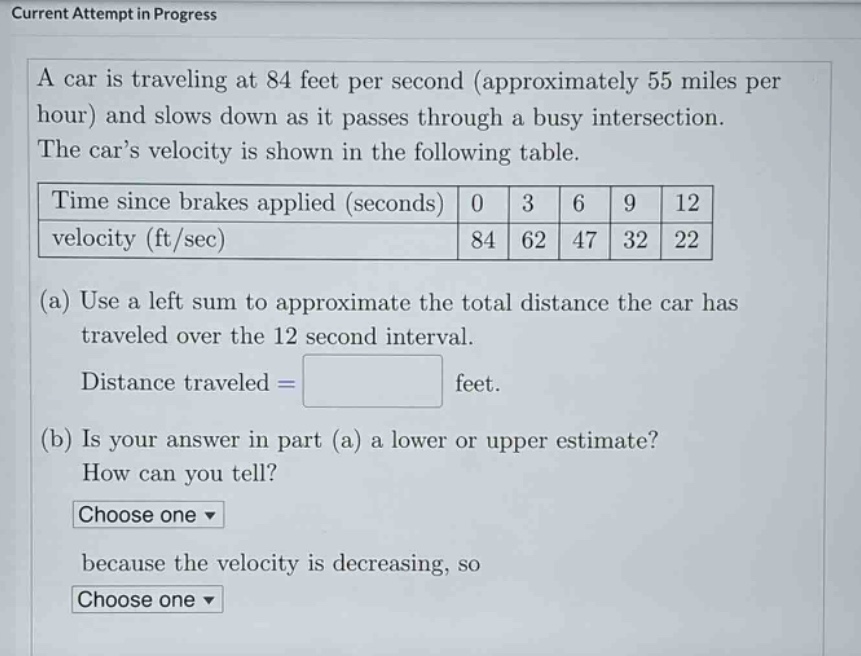
current attempt in progress\na car is traveling at 84 feet per second (approximately 55 miles per hour) and slows down as it passes through a busy intersection. the car’s velocity is shown in the following table.\ntime since brakes applied (seconds) 0 3 6 9 12\nvelocity (ft/sec) 84 62 47 32 22\n(a) use a left sum to approximate the total distance the car has traveled over the 12 - second interval.\ndistance traveled = \n(b) is your answer in part (a) a lower or upper estimate? how can you tell?\nchoose one \nbecause the velocity is decreasing, so\nchoose one
Answer
Explanation:
Step1: Identify the time - interval
The time - interval $\Delta t$ between consecutive time values is $3$ seconds ($3 - 0=6 - 3 = 9 - 6=12 - 9 = 3$).
Step2: Apply the left - sum formula for distance
The left - sum formula for distance $D$ using a velocity function $v(t)$ over the interval $[a,b]$ with $n$ sub - intervals of width $\Delta t$ is $D\approx\sum_{i = 0}^{n - 1}v(t_i)\Delta t$. Here, $n = 4$ (since we are dividing the 12 - second interval into 4 sub - intervals of width $\Delta t=3$), $t_0 = 0$, $t_1 = 3$, $t_2 = 6$, $t_3 = 9$, and $v(0)=84$, $v(3)=62$, $v(6)=47$, $v(9)=32$. [ \begin{align*} D&\approx v(0)\times3+v(3)\times3+v(6)\times3+v(9)\times3\ &=3\times(84 + 62+47+32)\ &=3\times(225)\ & = 675 \end{align*} ]
Step3: Determine if it's a lower or upper estimate
Since the velocity function $v(t)$ is decreasing (the car is slowing down), the left - sum is an upper estimate. In a left - sum, we use the velocity at the left - hand endpoint of each sub - interval. For a decreasing function, the velocity values used in the left - sum are larger than the average velocity over each sub - interval.
Answer:
(a) 675 (b) Upper estimate; the left - sum uses larger velocities for each sub - interval when the velocity function is decreasing.