current attempt in progress\nyour answer is incorrect.\nthe figure below shows the velocity v(t) in ft/sec…
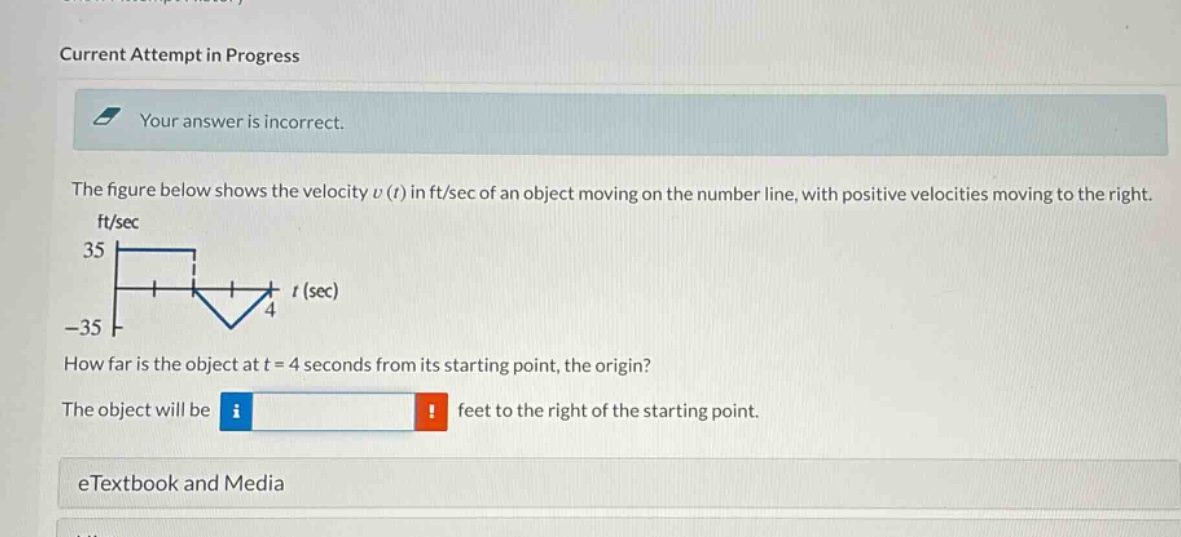
current attempt in progress\nyour answer is incorrect.\nthe figure below shows the velocity v(t) in ft/sec of an object moving on the number line, with positive velocities moving to the right.\nhow far is the object at t = 4 seconds from its starting point, the origin?\nthe object will be feet to the right of the starting point.\netextbook and media
Answer
Explanation:
Step1: Analyze the velocity - time graph
The displacement of an object from the starting - point is given by the net area under the velocity - time graph. The area above the time - axis is positive (right - ward motion) and the area below the time - axis is negative (left - ward motion).
Step2: Calculate the area of the first part
The first part of the graph is a rectangle from (t = 0) to (t = 1) with height (v=35) ft/sec and base (b = 1) sec. The area of a rectangle (A_{1}) is (A_{1}=35\times1 = 35) square feet.
Step3: Calculate the area of the second part
The second part of the graph is a triangle from (t = 1) to (t = 4) with height (h=- 35) ft/sec and base (b = 3) sec. The area of a triangle (A=\frac{1}{2}\times base\times height), so (A_{2}=\frac{1}{2}\times3\times(-35)=-\frac{105}{2}=- 52.5) square feet.
Step4: Calculate the net displacement
The net displacement (D) is the sum of the areas, (D=A_{1}+A_{2}). So (D = 35-52.5=-17.5) feet. The negative sign means the object is to the left of the starting - point. The distance from the starting - point is (|D| = 17.5) feet.
Answer:
17.5