current objective find the area of a region bounded above by two different functions question determine the…
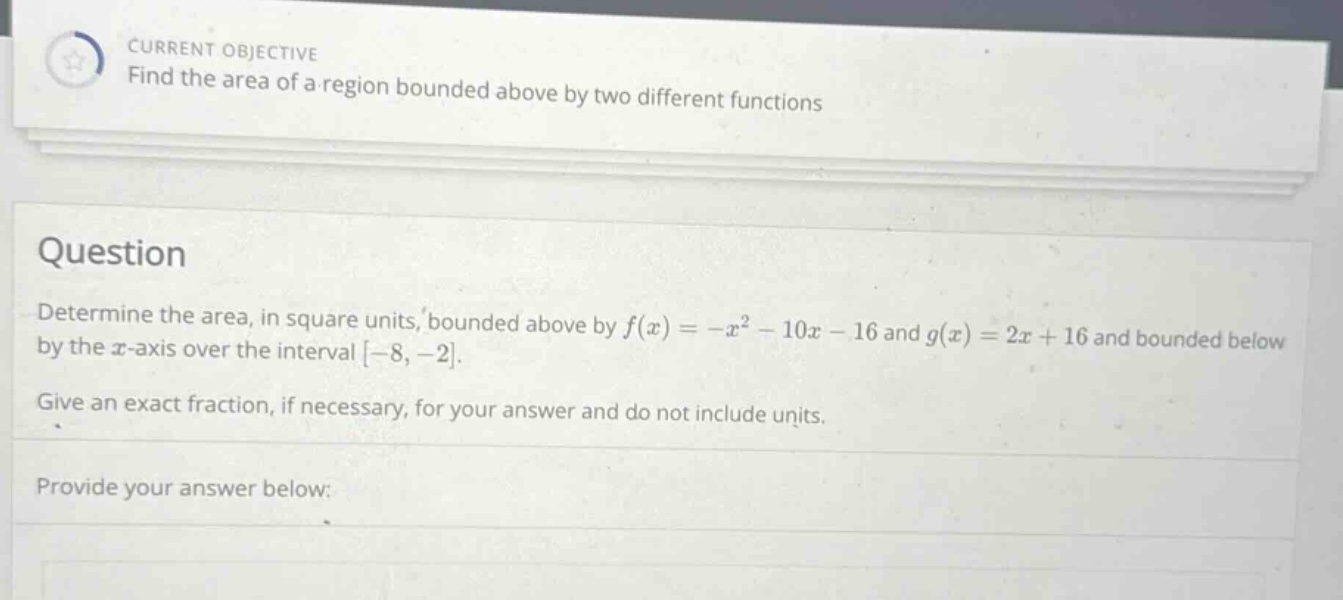
current objective find the area of a region bounded above by two different functions question determine the area, in square units, bounded above by f(x)=-x² - 10x - 16 and g(x)=2x + 16 and bounded below by the x - axis over the interval -8, -2. give an exact fraction, if necessary, for your answer and do not include units. provide your answer below:
Answer
Explanation:
Step1: Determine the upper - function
We need to find which of $f(x)=-x^{2}-10x - 16$ and $g(x)=2x + 16$ is greater on the interval $[-8,-2]$. Let's find the difference $h(x)=g(x)-f(x)=(2x + 16)-(-x^{2}-10x - 16)=x^{2}+12x + 32=(x + 4)(x+8)$. The roots of $h(x)$ are $x=-8$ and $x = - 4$. On the interval $[-8,-4]$, $f(x)\geq g(x)$ and on the interval $[-4,-2]$, $g(x)\geq f(x)$.
Step2: Set up the integral for the area
The area $A$ between two curves $y = f(x)$ and $y = g(x)$ and the $x$-axis on $[a,b]$ is given by $A=\int_{a}^{c}f(x)dx+\int_{c}^{b}g(x)dx$, where $c$ is the point of intersection of $f(x)$ and $g(x)$ in $[a,b]$. Here $a=-8$, $c = - 4$, $b=-2$. [ \begin{align*} A&=\int_{-8}^{-4}(-x^{2}-10x - 16)dx+\int_{-4}^{-2}(2x + 16)dx\ \end{align*} ]
Step3: Integrate the first integral
[ \begin{align*} \int_{-8}^{-4}(-x^{2}-10x - 16)dx&=-\int_{-8}^{-4}x^{2}dx-10\int_{-8}^{-4}xdx-16\int_{-8}^{-4}dx\ &=-\left[\frac{x^{3}}{3}\right]{-8}^{-4}-10\left[\frac{x^{2}}{2}\right]{-8}^{-4}-16[x]_{-8}^{-4}\ &=-\left(\frac{(-4)^{3}}{3}-\frac{(-8)^{3}}{3}\right)-10\left(\frac{(-4)^{2}}{2}-\frac{(-8)^{2}}{2}\right)-16((-4)-(-8))\ &=-\left(-\frac{64}{3}+\frac{512}{3}\right)-10(8 - 32)-16(4)\ &=-\frac{448}{3}+240 - 64\ &=-\frac{448}{3}+176\ &=-\frac{448}{3}+\frac{528}{3}\ &=\frac{80}{3} \end{align*} ]
Step4: Integrate the second integral
[ \begin{align*} \int_{-4}^{-2}(2x + 16)dx&=2\int_{-4}^{-2}xdx+16\int_{-4}^{-2}dx\ &=2\left[\frac{x^{2}}{2}\right]{-4}^{-2}+16[x]{-4}^{-2}\ &=( (-2)^{2}-(-4)^{2})+16((-2)-(-4))\ &=(4 - 16)+16(2)\ &=-12 + 32\ &=20 \end{align*} ]
Step5: Calculate the total area
[ \begin{align*} A&=\frac{80}{3}+20\ &=\frac{80 + 60}{3}\ &=\frac{140}{3} \end{align*} ]
Answer:
$\frac{140}{3}$