current objective find the area of a region bounded above by two different functions question consider the…
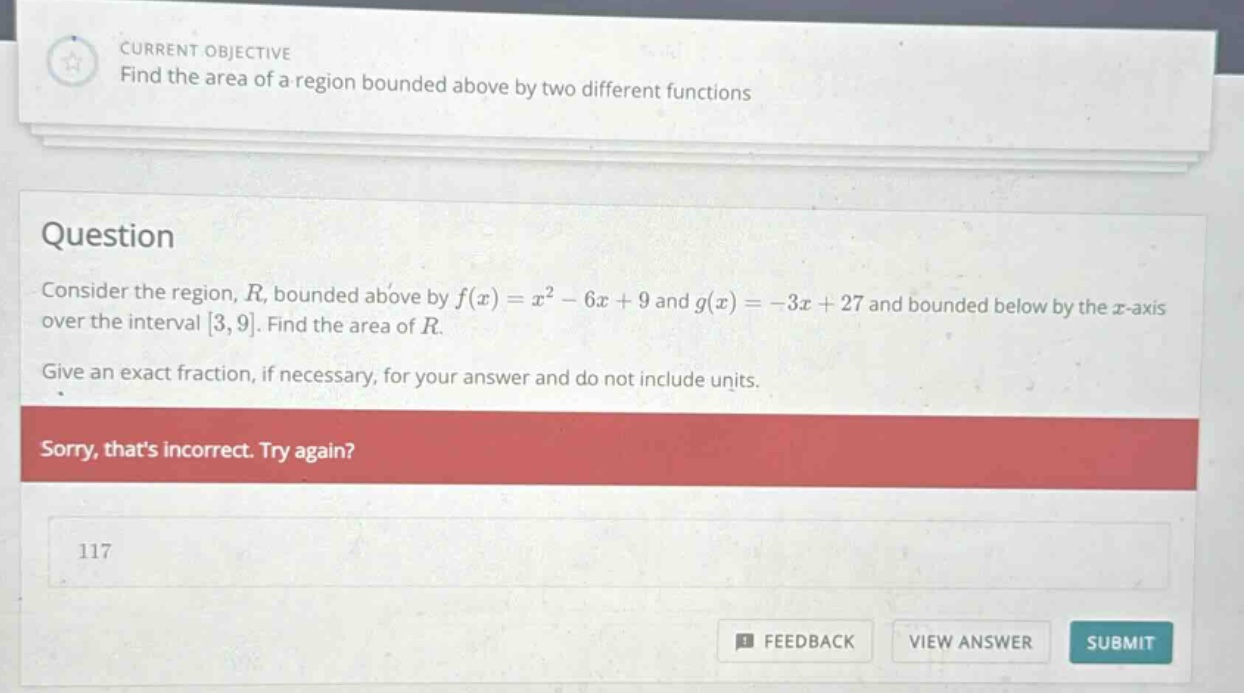
current objective find the area of a region bounded above by two different functions question consider the region, r, bounded above by f(x)=x² - 6x + 9 and g(x)= - 3x + 27 and bounded below by the x - axis over the interval 3,9. find the area of r. give an exact fraction, if necessary, for your answer and do not include units. sorry, thats incorrect. try again? 117 feedback view answer submit
Answer
Explanation:
Step1: Determine the upper - function
We need to find which of $f(x)=x^{2}-6x + 9$ and $g(x)=-3x + 27$ is greater on the interval $[3,9]$. Let $h(x)=f(x)-g(x)=x^{2}-6x + 9-(-3x + 27)=x^{2}-3x - 18$. Factor $h(x)$: $h(x)=(x - 6)(x+3)$. The roots of $h(x)$ are $x=-3$ and $x = 6$. On the interval $[3,6)$, $h(x)<0$, so $g(x)>f(x)$; on the interval $(6,9]$, $h(x)>0$, so $f(x)>g(x)$.
Step2: Set up the integral for the area
The area $A$ of the region $R$ is given by $A=\int_{3}^{6}g(x)dx+\int_{6}^{9}f(x)dx$. First, calculate $\int_{3}^{6}(-3x + 27)dx$. Using the power - rule $\int x^{n}dx=\frac{x^{n + 1}}{n+1}+C(n\neq - 1)$, we have $\int(-3x + 27)dx=-\frac{3}{2}x^{2}+27x+C$. Then $\int_{3}^{6}(-3x + 27)dx=\left(-\frac{3}{2}(6)^{2}+27\times6\right)-\left(-\frac{3}{2}(3)^{2}+27\times3\right)=\left(-54 + 162\right)-\left(-\frac{27}{2}+81\right)=108-(81-\frac{27}{2})=108 - 81+\frac{27}{2}=27+\frac{27}{2}=\frac{54 + 27}{2}=\frac{81}{2}$. Second, calculate $\int_{6}^{9}(x^{2}-6x + 9)dx$. Using the power - rule, $\int(x^{2}-6x + 9)dx=\frac{1}{3}x^{3}-3x^{2}+9x+C$. Then $\int_{6}^{9}(x^{2}-6x + 9)dx=\left(\frac{1}{3}(9)^{3}-3(9)^{2}+9\times9\right)-\left(\frac{1}{3}(6)^{3}-3(6)^{2}+9\times6\right)=\left(243-243 + 81\right)-\left(72-108 + 54\right)=81-(18)=63$.
Step3: Calculate the total area
$A=\frac{81}{2}+63=\frac{81+126}{2}=\frac{207}{2}$.
Answer:
$\frac{207}{2}$