9. which curve (by color) is the standard curve for $y = \\sin x$?\n10. identify the amplitude, period and…
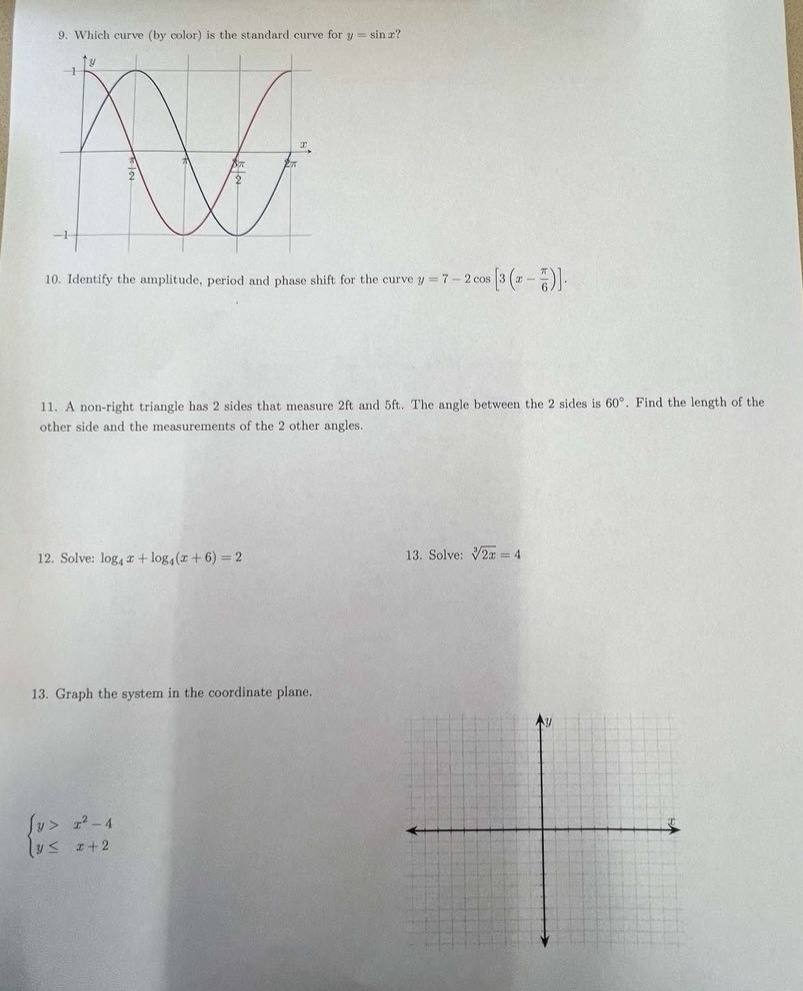
9. which curve (by color) is the standard curve for $y = \\sin x$?\n10. identify the amplitude, period and phase shift for the curve $y = 7 - 2\\cos3(x - \\frac{\\pi}{6})$.\n11. a non - right triangle has 2 sides that measure 2ft and 5ft. the angle between the 2 sides is $60^{circ}$. find the length of the other side and the measurements of the 2 other angles.\n12. solve: $\\log_4x+\\log_4(x + 6)=2$\n13. solve: $\\sqrt3{2x}=4$\n13. graph the system in the coordinate plane.\n$\\begin{cases}y>x^{2}-4\\yleq x + 2\\end{cases}$
Answer
9.
Explanation:
Step1: Recall sine - curve properties
The standard curve of (y = \sin x) has an amplitude of 1, a period of (2\pi), and passes through the origin ((0,0)). It starts at the origin, goes up to 1 at (x=\frac{\pi}{2}), back to 0 at (x = \pi), down to - 1 at (x=\frac{3\pi}{2}) and back to 0 at (x = 2\pi). Without seeing the colors in the figure, we assume the curve with these properties is the one that starts at the origin and has the correct wave - like pattern.
Answer:
(No color information given in the text, but the curve with amplitude 1, passing through ((0,0)) and having period (2\pi) is the standard (y=\sin x) curve)
10.
Explanation:
Step1: Rewrite the cosine function in standard form
The general form of a cosine function is (y = A\cos(B(x - C))+D). Given (y = 7-2\cos\left[3\left(x-\frac{\pi}{6}\right)\right]= - 2\cos\left(3x-\frac{\pi}{2}\right)+7). Here, (A=-2), (B = 3), (C=\frac{\pi}{6}), (D = 7).
Step2: Calculate the amplitude
The amplitude is (|A|). So, (|A|=| - 2|=2).
Step3: Calculate the period
The period (T=\frac{2\pi}{|B|}). Since (B = 3), (T=\frac{2\pi}{3}).
Step4: Calculate the phase - shift
The phase - shift is (C=\frac{\pi}{6}).
Answer:
Amplitude: 2, Period: (\frac{2\pi}{3}), Phase - shift: (\frac{\pi}{6})
11.
Explanation:
Step1: Use the Law of Cosines to find the third side
The Law of Cosines for a triangle with sides (a), (b), (c) and the angle (C) between sides (a) and (b) is (c^{2}=a^{2}+b^{2}-2ab\cos C). Let (a = 2), (b = 5), (C = 60^{\circ}) and (\cos C=\frac{1}{2}). Then (c^{2}=2^{2}+5^{2}-2\times2\times5\times\frac{1}{2}=4 + 25-10=19), so (c=\sqrt{19}\approx4.36) ft.
Step2: Use the Law of Sines to find the other angles
The Law of Sines is (\frac{\sin A}{a}=\frac{\sin B}{b}=\frac{\sin C}{c}). We know (C = 60^{\circ}), (a = 2), (b = 5), (c=\sqrt{19}). First, (\sin A=\frac{a\sin C}{c}=\frac{2\times\sin60^{\circ}}{\sqrt{19}}=\frac{2\times\frac{\sqrt{3}}{2}}{\sqrt{19}}=\frac{\sqrt{3}}{\sqrt{19}}), so (A=\sin^{-1}\left(\frac{\sqrt{3}}{\sqrt{19}}\right)\approx23.4^{\circ}). Then (B=180^{\circ}-A - C=180^{\circ}-23.4^{\circ}-60^{\circ}=96.6^{\circ}).
Answer:
Length of the other side: (\sqrt{19}\approx4.36) ft, Angles: approximately (23.4^{\circ}) and (96.6^{\circ})
12.
Explanation:
Step1: Use the logarithmic property (\log_aM+\log_aN=\log_a(MN))
Given (\log_4x+\log_4(x + 6)=2), we can rewrite it as (\log_4[x(x + 6)]=2).
Step2: Convert the logarithmic equation to an exponential equation
By the definition of logarithms, if (\log_ax=b), then (x=a^{b}). So, (x(x + 6)=4^{2}=16).
Step3: Expand and solve the quadratic equation
Expand (x(x + 6)=16) to get (x^{2}+6x-16=0). Factor the quadratic equation: ((x + 8)(x - 2)=0). So, (x=-8) or (x = 2). But since the argument of a logarithm must be positive ((x>0) and (x + 6>0)), we reject (x=-8).
Answer:
(x = 2)
13.
Explanation:
Step1: Cube both sides of the equation
Given (\sqrt[3]{2x}=4), cubing both sides gives ((\sqrt[3]{2x})^3=4^3).
Step2: Simplify the equation
(2x=64).
Step3: Solve for (x)
Divide both sides by 2: (x = 32).
Answer:
(x = 32)
14.
Explanation:
Step1: Graph (y=x^{2}-4)
The parabola (y=x^{2}-4) has a vertex at ((0,-4)) and opens upwards. To graph (y>x^{2}-4), we shade the region above the parabola.
Step2: Graph (y=x + 2)
The line (y=x + 2) has a (y) - intercept of 2 and a slope of 1. To graph (y\leq x + 2), we draw a solid line (because of the (\leq) sign) and shade the region below the line.
Step3: Find the intersection points
Set (x^{2}-4=x + 2), then (x^{2}-x-6=0). Factor to get ((x - 3)(x+2)=0). So (x=-2) or (x = 3). When (x=-2), (y=0); when (x = 3), (y=5). The intersection points are ((-2,0)) and ((3,5)). The solution of the system is the region that is above the parabola (y=x^{2}-4) and below or on the line (y=x + 2).
Answer:
Graph the parabola (y=x^{2}-4) (open - up, vertex at ((0,-4))) and shade above it, graph the line (y=x + 2) (slope 1, (y) - intercept 2) as a solid line and shade below it. The intersection points are ((-2,0)) and ((3,5)) and the solution region is the overlapping shaded region.