the curve above is the graph of a sinusoidal function. it goes through the points (-8, -1) and (6, -1). find…
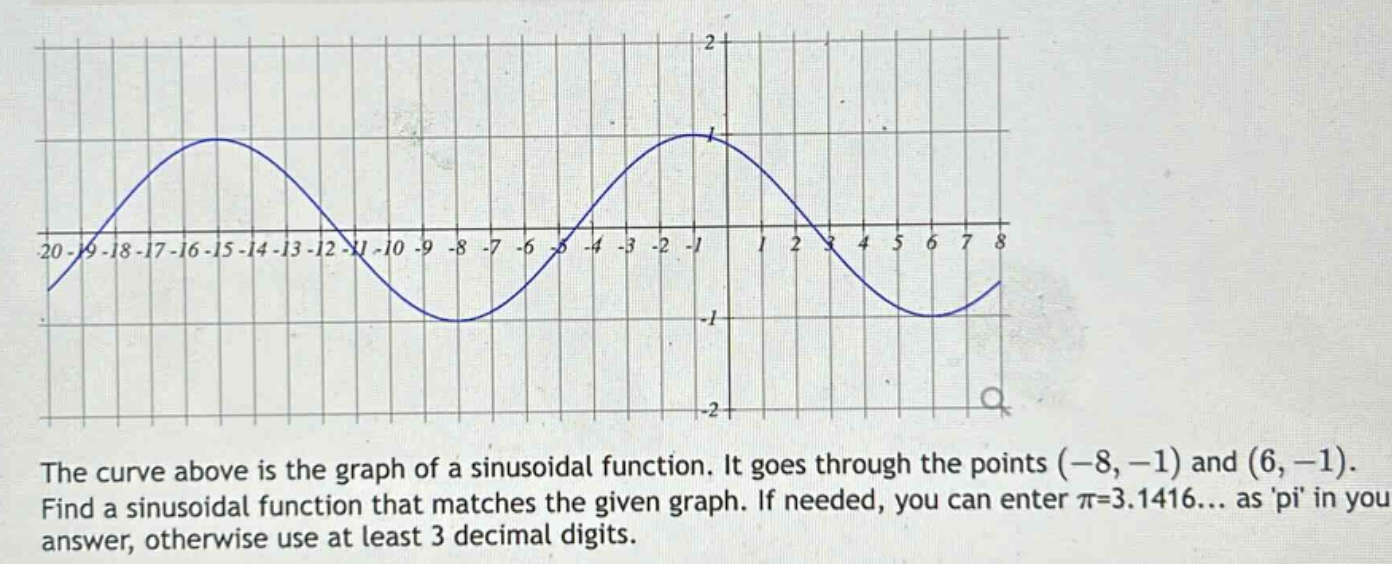
the curve above is the graph of a sinusoidal function. it goes through the points (-8, -1) and (6, -1). find a sinusoidal function that matches the given graph. if needed, you can enter π=3.1416... as pi in your answer, otherwise use at least 3 decimal digits.
Answer
Explanation:
Step1: Find the period
The distance between two consecutive minimum - points (or any two corresponding points with the same phase) gives the period. The points $(-8,-1)$ and $(6, - 1)$ are two consecutive minimum - points. The period $T$ is $T=6-( - 8)=14$. Using the formula $T=\frac{2\pi}{\omega}$, we can find $\omega$. Since $T = 14$, then $\omega=\frac{2\pi}{T}=\frac{2\pi}{14}=\frac{\pi}{7}$.
Step2: Determine the amplitude
The amplitude $A$ is the distance from the mid - line to the maximum or minimum value of the function. The mid - line is $y = 0$ (since the maximum value is $y = 1$ and the minimum value is $y=-1$), and the amplitude $A = 1$.
Step3: Find the vertical shift
The vertical shift $D$ is the $y$ - value of the mid - line. Here, $D = 0$.
Step4: Find the phase shift
We can use the general form of a sinusoidal function $y = A\sin(\omega(x - \varphi))+D$. Let's assume the function is of the form $y=\sin(\omega(x - \varphi))$. Using the point $(-8,-1)$ and $\omega=\frac{\pi}{7}$, we have $-1=\sin(\frac{\pi}{7}(-8-\varphi))$. Since $\sin(\theta)=-1$ when $\theta=\frac{3\pi}{2}+2k\pi,k\in\mathbb{Z}$, we set $\frac{\pi}{7}(-8 - \varphi)=\frac{3\pi}{2}+2k\pi$. Solving for $\varphi$: [ \begin{align*} \frac{\pi}{7}(-8 - \varphi)&=\frac{3\pi}{2}+2k\pi\ -8-\varphi&=\frac{21}{2}+14k\ \varphi&=-8-\frac{21}{2}-14k\ \varphi&=-\frac{16 + 21}{2}-14k\ \varphi&=-\frac{37}{2}-14k \end{align*} ] Let $k = - 1$, then $\varphi=-\frac{37}{2}+14=-\frac{37 - 28}{2}=-\frac{9}{2}$. A sinusoidal function is $y=\sin(\frac{\pi}{7}(x+\frac{9}{2}))$.
Answer:
$y = \sin(\frac{\pi}{7}(x+\frac{9}{2}))$