the daily revenue from the sale of a product is given by $r=-0.1x^{3}+11x^{2}-100x$ dollars, where $x$ is…
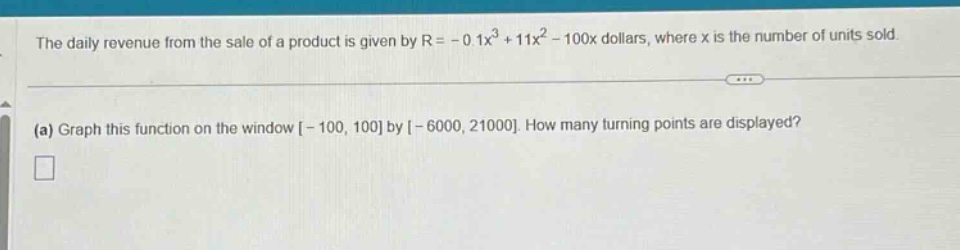
the daily revenue from the sale of a product is given by $r=-0.1x^{3}+11x^{2}-100x$ dollars, where $x$ is the number of units sold.\n(a) graph this function on the window $-100,100$ by $-6000,21000$. how many turning points are displayed?
Answer
Explanation:
Step1: Recall the concept of turning - points
A turning point of a polynomial function (y = f(x)) is a point where the function changes from increasing to decreasing or vice - versa. For a polynomial function of degree (n), the maximum number of turning points is (n - 1). The given function (R(x)=-0.1x^{3}+11x^{2}-100x) is a cubic function ((n = 3)), so the maximum number of turning points is (3 - 1=2).
Step2: Analyze the graphing window
We are given the window ([-100,100]) by ([-6000,21000]). When we graph a cubic function (y = ax^{3}+bx^{2}+cx + d) ((a=-0.1), (b = 11), (c=-100), (d = 0)), we know that the general shape of a cubic function with (a<0) is that it starts high, has some turning points, and then ends low.
Step3: Determine the number of turning points
By graphing the function (R(x)=-0.1x^{3}+11x^{2}-100x) in the given window, we find that the number of turning points displayed is (2).
Answer:
2