decide if the function is an exponential growth function or exponential decay function, and describe its end…
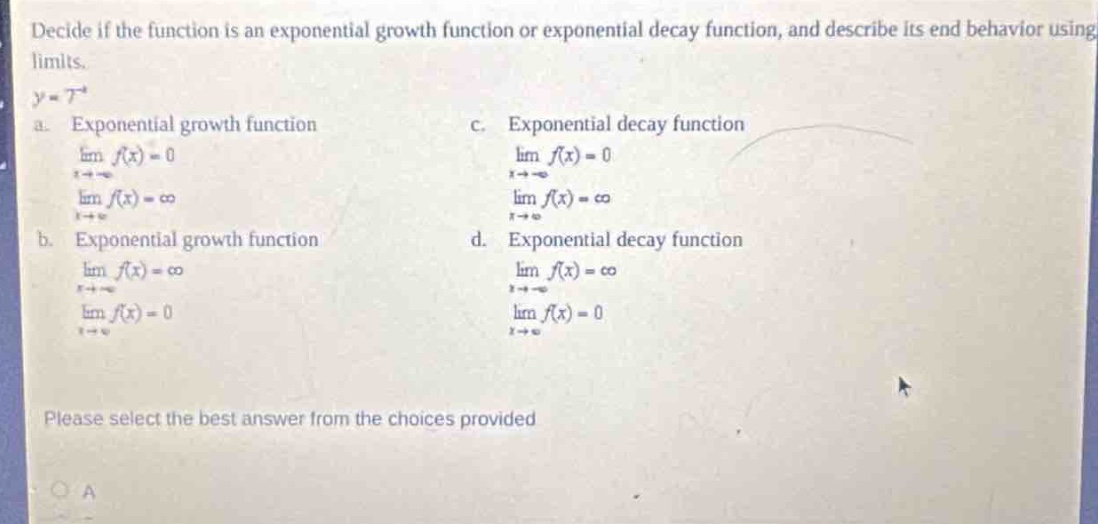
decide if the function is an exponential growth function or exponential decay function, and describe its end - behavior using limits.\ny = 7^x\na. exponential growth function\nlim_{x\\to - \\infty}f(x)=0\nlim_{x\\to\\infty}f(x)=\\infty\nb. exponential growth function\nlim_{x\\to\\infty}f(x)=\\infty\nlim_{x\\to - \\infty}f(x)=0\nc. exponential decay function\nlim_{x\\to - \\infty}f(x)=0\nlim_{x\\to\\infty}f(x)=\\infty\nd. exponential decay function\nlim_{x\\to\\infty}f(x)=\\infty\nlim_{x\\to - \\infty}f(x)=0\nplease select the best answer from the choices provided
Answer
Explanation:
Step1: Recall exponential - function form
The general form of an exponential function is $y = a\cdot b^{x}$, where $a\neq0$, $b>0$ and $b\neq1$. For the function $y = 7^{x}$, we have $a = 1$ and $b=7>1$.
Step2: Determine growth or decay
If $b > 1$ in the function $y=a\cdot b^{x}$, it is an exponential growth function. Since $b = 7>1$ for $y = 7^{x}$, it is an exponential growth function.
Step3: Analyze end - behavior using limits
As $x\to-\infty$, we consider $\lim_{x\to-\infty}7^{x}$. Let $t=-x$, then as $x\to-\infty$, $t\to\infty$ and $\lim_{x\to-\infty}7^{x}=\lim_{t\to\infty}\frac{1}{7^{t}} = 0$. As $x\to\infty$, we consider $\lim_{x\to\infty}7^{x}=\infty$ because as $x$ gets larger and larger, the value of $7^{x}$ increases without bound.
Answer:
B. Exponential growth function, $\lim_{x\to-\infty}f(x)=0$, $\lim_{x\to\infty}f(x)=\infty$