decide whether the following statement is true or false. if the degree of the numerator of a rational…
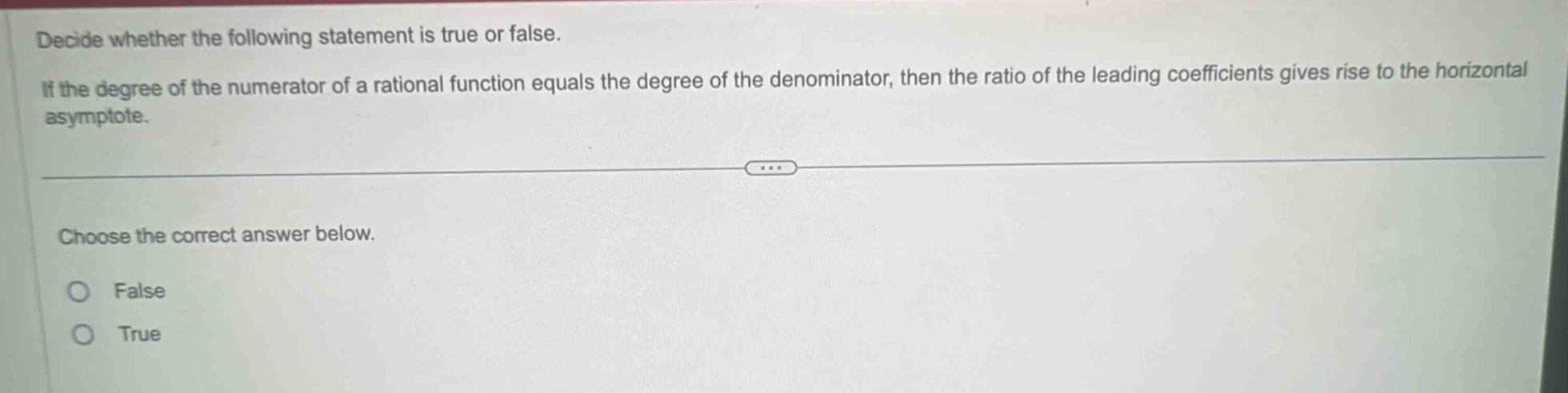
decide whether the following statement is true or false. if the degree of the numerator of a rational function equals the degree of the denominator, then the ratio of the leading coefficients gives rise to the horizontal asymptote. choose the correct answer below. false true
Answer
Explanation:
Step1: Recall rational - function rule
For a rational function $f(x)=\frac{a_nx^n + a_{n - 1}x^{n - 1}+\cdots+a_0}{b_nx^n + b_{n - 1}x^{n - 1}+\cdots+b_0}$, where $n$ is the degree of the numerator and denominator ($n\geq0$).
Step2: Analyze horizontal asymptote
As $x\to\pm\infty$, we divide both the numerator and denominator by $x^n$. Then $f(x)=\frac{a_n+\frac{a_{n - 1}}{x}+\cdots+\frac{a_0}{x^n}}{b_n+\frac{b_{n - 1}}{x}+\cdots+\frac{b_0}{x^n}}$. As $x\to\pm\infty$, the terms with $\frac{1}{x},\frac{1}{x^2},\cdots,\frac{1}{x^n}$ approach 0. So, $\lim_{x\to\pm\infty}f(x)=\frac{a_n}{b_n}$, which is the horizontal asymptote.
Answer:
True