definite integrals with a graph\n61. the graph below consists of line segments and a semi - circle. use…
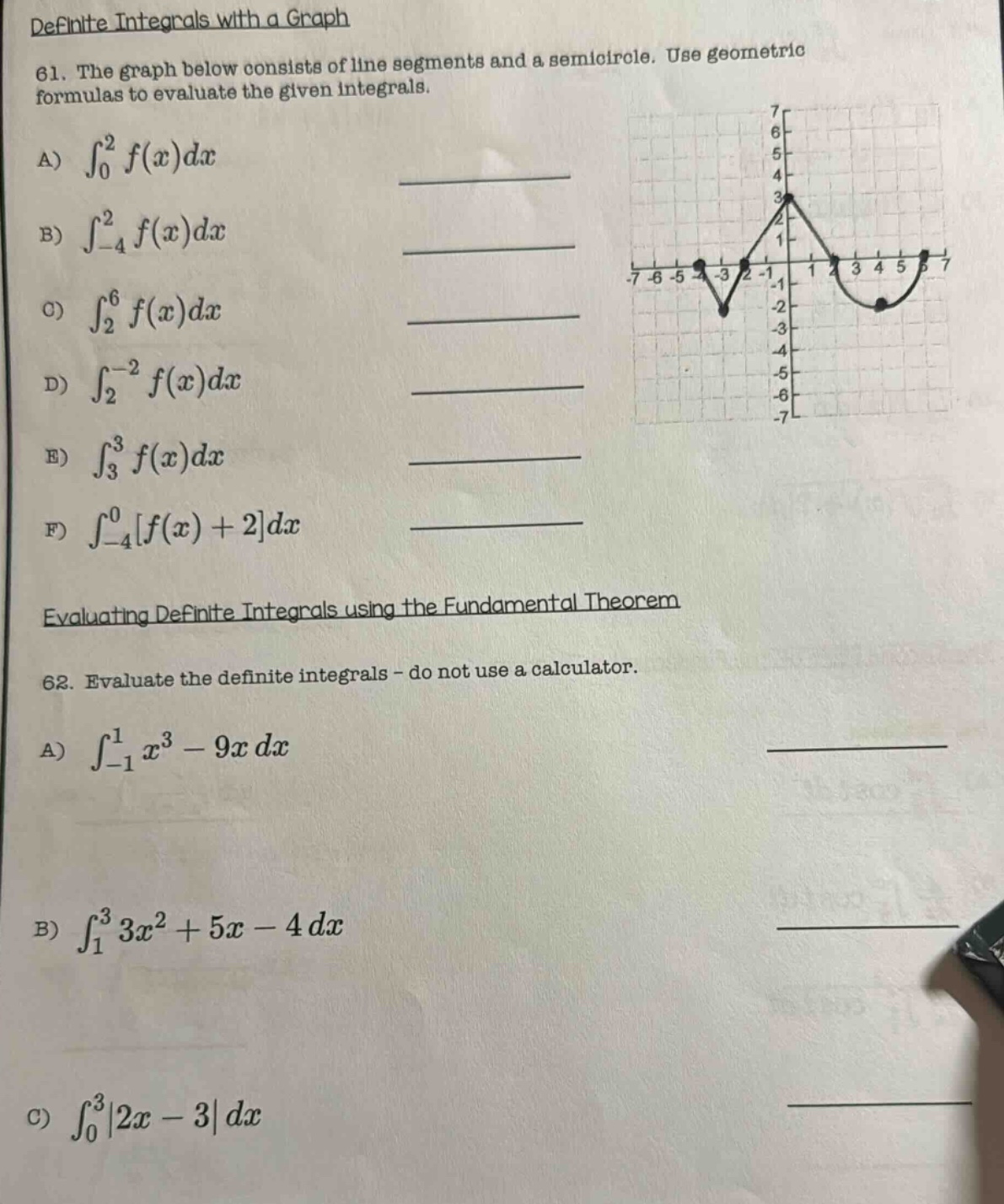
definite integrals with a graph\n61. the graph below consists of line segments and a semi - circle. use geometric formulas to evaluate the given integrals.\na) ∫₀² f(x)dx\nb) ∫₋₄² f(x)dx\nc) ∫₂⁶ f(x)dx\nd) ∫₂⁻² f(x)dx\ne) ∫₃³ f(x)dx\nf) ∫₋₄⁰ f(x)+2dx\nevaluating definite integrals using the fundamental theorem\n62. evaluate the definite integrals - do not use a calculator.\na) ∫₋₁¹ x³ - 9x dx\nb) ∫₁³ 3x² + 5x - 4 dx\nc) ∫₀³ |2x - 3| dx
Answer
Explanation:
61. A)
Step1: Identify geometric shape
The region for $\int_{0}^{2}f(x)dx$ is a triangle with base $b = 2$ and height $h=3$.
Step2: Apply triangle - area formula
The area of a triangle is $A=\frac{1}{2}bh$. So $A=\frac{1}{2}\times2\times3 = 3$.
61. B)
Step1: Split the integral
$\int_{-4}^{2}f(x)dx=\int_{-4}^{-2}f(x)dx+\int_{-2}^{2}f(x)dx$. The region from $x = - 4$ to $x=-2$ is a triangle with base $b = 2$ and height $h = 2$ (negative - valued area as it is below the $x$ - axis), and the region from $x=-2$ to $x = 2$ is a triangle with base $b = 4$ and height $h = 3$.
Step2: Calculate areas
The area of the first triangle $A_1=-\frac{1}{2}\times2\times2=-2$, and the area of the second triangle $A_2=\frac{1}{2}\times4\times3 = 6$. Then $\int_{-4}^{2}f(x)dx=-2 + 6=4$.
61. C)
Step1: Identify geometric shapes
The region for $\int_{2}^{6}f(x)dx$ consists of a triangle and a semi - circle. The triangle has base $b = 2$ and height $h = 3$, and the semi - circle has radius $r = 2$.
Step2: Calculate areas
The area of the triangle $A_1=\frac{1}{2}\times2\times3 = 3$, and the area of the semi - circle $A_2=-\frac{1}{2}\pi r^{2}=-\frac{1}{2}\pi\times2^{2}=-2\pi$. So $\int_{2}^{6}f(x)dx=3-2\pi$.
61. D)
Step1: Reverse the limits
$\int_{2}^{-2}f(x)dx=-\int_{-2}^{2}f(x)dx$. The region from $x=-2$ to $x = 2$ is a triangle with base $b = 4$ and height $h = 3$, so $\int_{-2}^{2}f(x)dx=\frac{1}{2}\times4\times3 = 6$. Then $\int_{2}^{-2}f(x)dx=-6$.
61. E)
Step1: Recognize zero - length integral
For $\int_{3}^{3}f(x)dx$, by the property of definite integrals $\int_{a}^{a}f(x)dx = 0$.
61. F)
Step1: Split the integral
$\int_{-4}^{0}[f(x)+2]dx=\int_{-4}^{0}f(x)dx+\int_{-4}^{0}2dx$. $\int_{-4}^{0}f(x)dx=\int_{-4}^{-2}f(x)dx+\int_{-2}^{0}f(x)dx$. The region from $x=-4$ to $x=-2$ is a triangle with base $b = 2$ and height $h = 2$ (negative area), and the region from $x=-2$ to $x = 0$ is a triangle with base $b = 2$ and height $h = 3$. $\int_{-4}^{0}2dx=2x\big|{-4}^{0}=0-(-8)=8$. $\int{-4}^{-2}f(x)dx=-\frac{1}{2}\times2\times2=-2$, $\int_{-2}^{0}f(x)dx=\frac{1}{2}\times2\times3 = 3$. So $\int_{-4}^{0}[f(x)+2]dx=-2 + 3+8=9$.
62. A)
Step1: Find antiderivative
The antiderivative of $x^{3}-9x$ is $F(x)=\frac{1}{4}x^{4}-\frac{9}{2}x^{2}+C$.
Step2: Apply the fundamental theorem of calculus
$\int_{-1}^{1}(x^{3}-9x)dx=F(1)-F(-1)=(\frac{1}{4}\times1^{4}-\frac{9}{2}\times1^{2})-(\frac{1}{4}\times(-1)^{4}-\frac{9}{2}\times(-1)^{2})=\left(\frac{1}{4}-\frac{9}{2}\right)-\left(\frac{1}{4}-\frac{9}{2}\right)=0$.
62. B)
Step1: Find antiderivative
The antiderivative of $3x^{2}+5x - 4$ is $F(x)=x^{3}+\frac{5}{2}x^{2}-4x+C$.
Step2: Apply the fundamental theorem of calculus
$\int_{1}^{3}(3x^{2}+5x - 4)dx=F(3)-F(1)=(3^{3}+\frac{5}{2}\times3^{2}-4\times3)-(1^{3}+\frac{5}{2}\times1^{2}-4\times1)=(27+\frac{45}{2}-12)-(1+\frac{5}{2}-4)=(15+\frac{45}{2})-(-3+\frac{5}{2})=15+\frac{45}{2}+3-\frac{5}{2}=18 + 20=38$.
62. C)
Step1: Split the integral based on the sign of $2x - 3$
$|2x - 3|=\begin{cases}3 - 2x, &x<\frac{3}{2}\2x - 3, &x\geq\frac{3}{2}\end{cases}$. So $\int_{0}^{3}|2x - 3|dx=\int_{0}^{\frac{3}{2}}(3 - 2x)dx+\int_{\frac{3}{2}}^{3}(2x - 3)dx$.
Step2: Find antiderivatives and apply the fundamental theorem
The antiderivative of $3 - 2x$ is $F_1(x)=3x - x^{2}+C$, and the antiderivative of $2x - 3$ is $F_2(x)=x^{2}-3x+C$. $\int_{0}^{\frac{3}{2}}(3 - 2x)dx=F_1(\frac{3}{2})-F_1(0)=(3\times\frac{3}{2}-\left(\frac{3}{2}\right)^{2})-(0)= \frac{9}{2}-\frac{9}{4}=\frac{9}{4}$. $\int_{\frac{3}{2}}^{3}(2x - 3)dx=F_2(3)-F_2(\frac{3}{2})=(3^{2}-3\times3)-(\left(\frac{3}{2}\right)^{2}-3\times\frac{3}{2})=0 - (\frac{9}{4}-\frac{9}{2})=\frac{9}{4}$. Then $\int_{0}^{3}|2x - 3|dx=\frac{9}{4}+\frac{9}{4}=\frac{9}{2}$.
Answer:
- A) $3$
- B) $4$
- C) $3 - 2\pi$
- D) $-6$
- E) $0$
- F) $9$
- A) $0$
- B) $38$
- C) $\frac{9}{2}$