density property: between any two real numbers, you can always find another real number. ex.1 2.4 and 2.5…
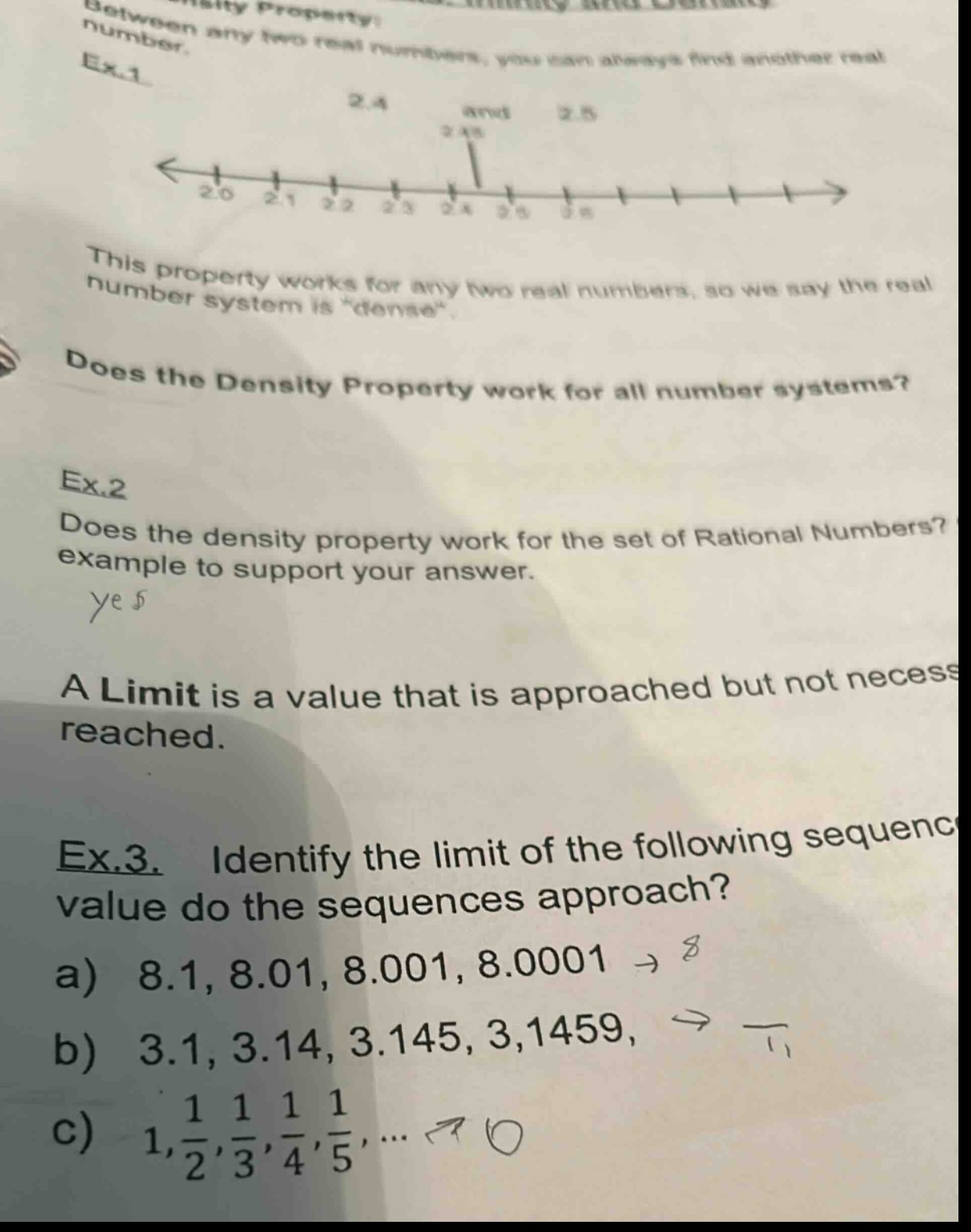
density property: between any two real numbers, you can always find another real number. ex.1 2.4 and 2.5 2.45 this property works for any two real numbers, so we say the real number system is “dense”. does the density property work for all number systems? ex.2 does the density property work for the set of rational numbers? give an example to support your answer. yes a limit is a value that is approached but not necessarily reached. ex.3. identify the limit of the following sequences. what value do the sequences approach? a) 8.1, 8.01, 8.001, 8.0001 → 8 b) 3.1, 3.14, 3.145, 3.1459, → c) 1, 1/2, 1/3, 1/4, 1/5, … → 0
Answer
Explanation:
Step1: Analyze sequence a
The sequence 8.1, 8.01, 8.001, 8.0001 is getting closer and closer to 8 as the number of decimal - places increases.
Step2: Analyze sequence b
The numbers 3.1, 3.14, 3.145, 3.1459 are approximations of $\pi\approx3.1415926\cdots$. So the limit is $\pi$.
Step3: Analyze sequence c
The sequence $1,\frac{1}{2},\frac{1}{3},\frac{1}{4},\frac{1}{5},\cdots$ has terms of the form $\frac{1}{n}$ where $n$ is a positive integer. As $n$ gets larger and larger, $\frac{1}{n}$ gets closer and closer to 0.
Answer:
a) 8 b) $\pi$ c) 0