the depth of the water at the end of a pier changes periodically along with the movement of tides. on a…
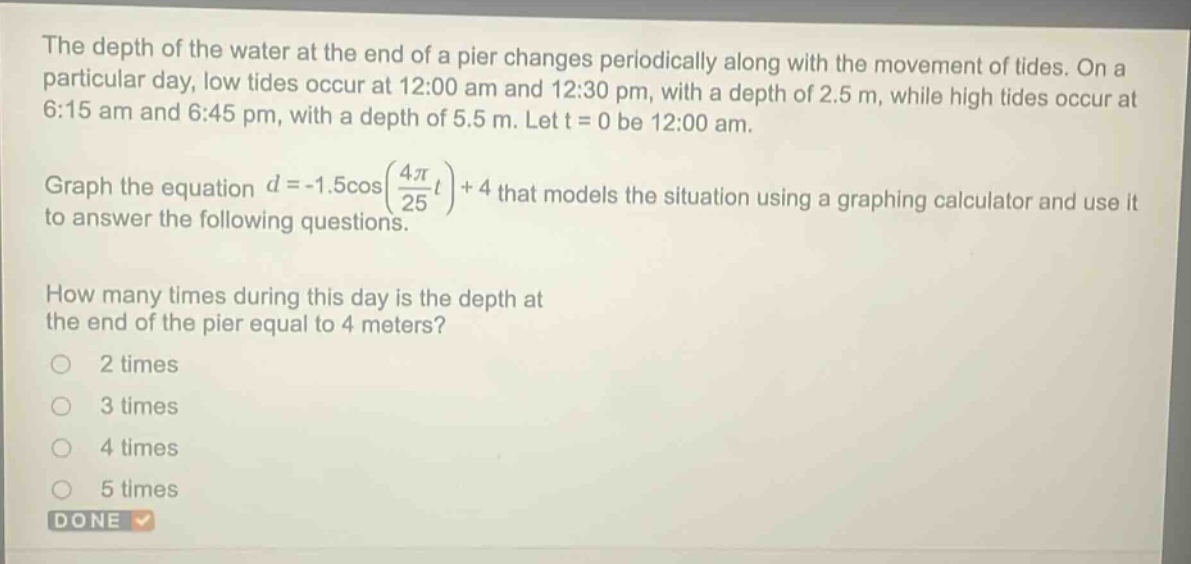
the depth of the water at the end of a pier changes periodically along with the movement of tides. on a particular day, low tides occur at 12:00 am and 12:30 pm, with a depth of 2.5 m, while high tides occur at 6:15 am and 6:45 pm, with a depth of 5.5 m. let t = 0 be 12:00 am. graph the equation d=-1.5cos((4π/25)t)+4 that models the situation using a graphing calculator and use it to answer the following questions. how many times during this day is the depth at the end of the pier equal to 4 meters? 2 times 3 times 4 times 5 times done
Answer
Explanation:
Step1: Set up the equation
Set $d = 4$ in the equation $d=-1.5\cos(\frac{4\pi}{25}t)+4$. So we get $4=-1.5\cos(\frac{4\pi}{25}t)+4$.
Step2: Simplify the equation
Subtract 4 from both sides of the equation: $0=-1.5\cos(\frac{4\pi}{25}t)$. Then $\cos(\frac{4\pi}{25}t)=0$.
Step3: Solve for $t$
We know that $\cos\theta = 0$ when $\theta=(2n + 1)\frac{\pi}{2}$, where $n$ is an integer. So $\frac{4\pi}{25}t=(2n + 1)\frac{\pi}{2}$. Cross - multiply to get $8t = 25(2n + 1)$, then $t=\frac{25(2n + 1)}{8}$.
Step4: Find the number of solutions in one day
The period of the cosine function $y = A\cos(Bt)+C$ is $T=\frac{2\pi}{B}$. Here $B=\frac{4\pi}{25}$, so $T=\frac{2\pi}{\frac{4\pi}{25}}=\frac{25}{2}=12.5$ hours (the time between consecutive low - tides or high - tides). In a 24 - hour day, we find non - negative values of $t$ for which the equation holds. When $n = 0$, $t=\frac{25}{8}=3.125$; when $n = 1$, $t=\frac{25\times3}{8}=9.375$; when $n = 2$, $t=\frac{25\times5}{8}=15.625$; when $n = 3$, $t=\frac{25\times7}{8}=21.875$.
Answer:
4 times