the derivative of a function g is given by g(x)=x^5 - 2x^2 + 2. how many points of inflection does the graph…
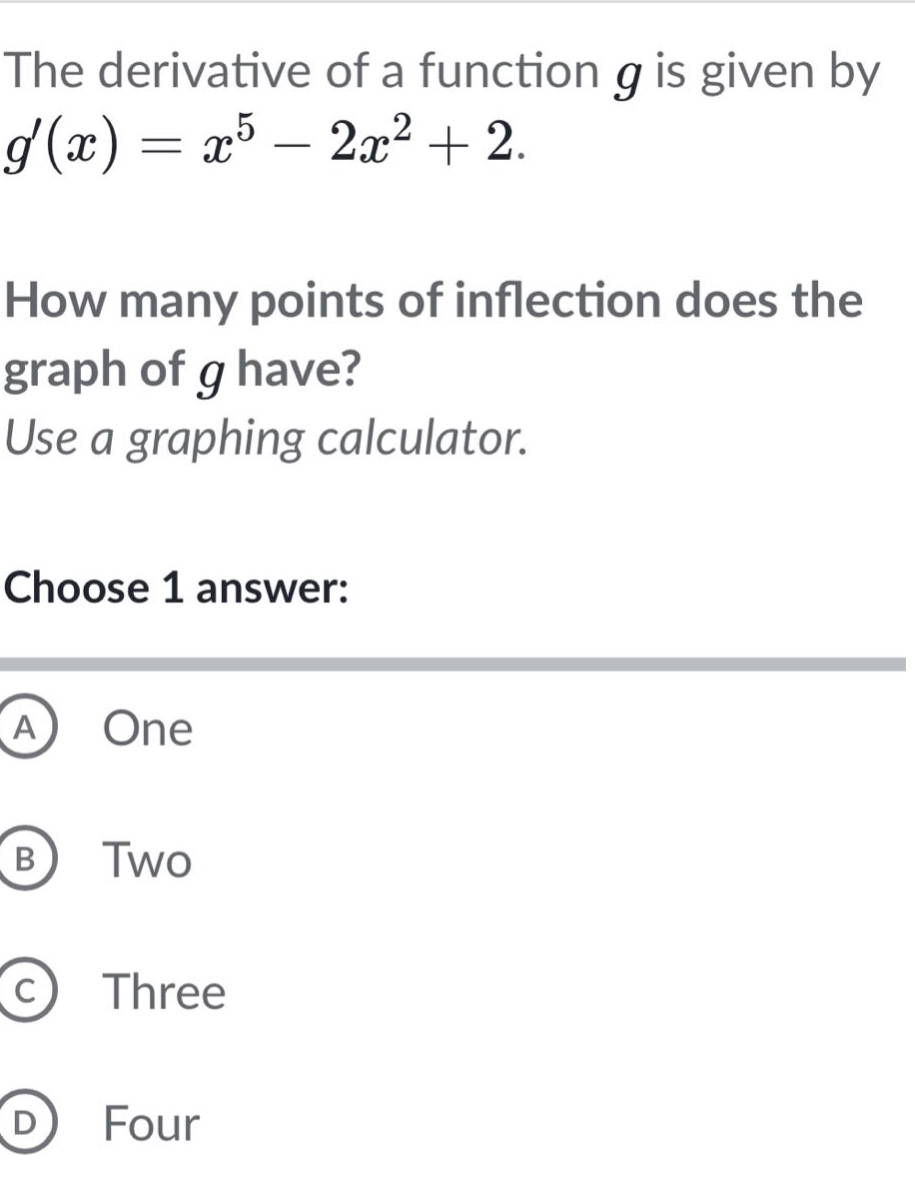
the derivative of a function g is given by g(x)=x^5 - 2x^2 + 2. how many points of inflection does the graph of g have? use a graphing calculator. choose 1 answer: a one b two c three d four
Answer
Explanation:
Step1: Recall inflection - point condition
Points of inflection occur where the second - derivative changes sign. First, find the second - derivative of (g(x)). Given (g^{\prime}(x)=x^{5}-2x^{2}+2), then (g^{\prime\prime}(x)=\frac{d}{dx}(x^{5}-2x^{2}+2)).
Step2: Differentiate (g^{\prime}(x))
Using the power rule (\frac{d}{dx}(x^{n}) = nx^{n - 1}), we have (g^{\prime\prime}(x)=5x^{4}-4x= x(5x^{3}-4)).
Step3: Find the zeros of (g^{\prime\prime}(x))
Set (g^{\prime\prime}(x)=0). Then (x(5x^{3}-4)=0). This gives two cases: (x = 0) and (5x^{3}-4=0). Solving (5x^{3}-4=0) for (x), we get (x^{3}=\frac{4}{5}), so (x=\sqrt[3]{\frac{4}{5}}).
Step4: Analyze sign - change of (g^{\prime\prime}(x))
We can use a sign - chart or a graphing calculator. The function (y = g^{\prime\prime}(x)) is a polynomial function. The zeros of (g^{\prime\prime}(x)) are (x = 0) and (x=\sqrt[3]{\frac{4}{5}}). The sign of (g^{\prime\prime}(x)) changes at these two points.
Answer:
B. Two