the derivative of the function $f$ is given by $f(x)=x^{2}-2 - 3xcos x$. on which of the following intervals…
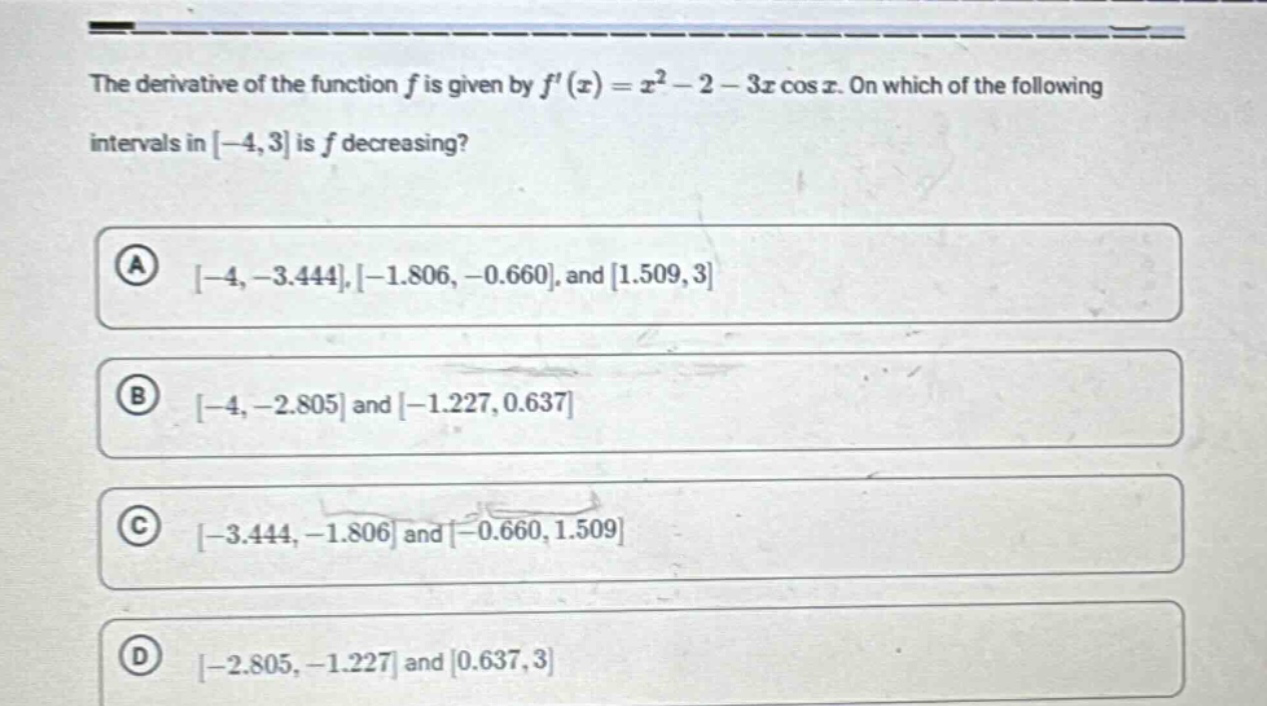
the derivative of the function $f$ is given by $f(x)=x^{2}-2 - 3xcos x$. on which of the following intervals in $-4,3$ is $f$ decreasing?\n(a) $-4,-3.444,-1.806,-0.660$, and $1.509,3$\n(b) $-4,-2.805$ and $-1.227,0.637$\n(c) $-3.444,-1.806$ and $-0.660,1.509$\n(d) $-2.805,-1.227$ and $0.637,3$
Answer
Explanation:
Step1: Recall the decreasing - function condition
A function $y = f(x)$ is decreasing when $f'(x)<0$. We need to find where $x^{2}-2 - 3x\cos x<0$ in the interval $[-4,3]$.
Step2: Use a graphing utility or numerical methods
Since it is difficult to solve the inequality $x^{2}-2 - 3x\cos x<0$ analytically, we can use a graphing calculator or a software like Desmos. Plot the function $y = x^{2}-2 - 3x\cos x$ in the interval $[-4,3]$.
Step3: Identify the intervals
By observing the graph of $y = x^{2}-2 - 3x\cos x$, we find the intervals where the graph is below the $x -$axis. The function $f(x)$ is decreasing when $f'(x)<0$. After graphing, we find that $f'(x)<0$ on the intervals $[-4,-3.444]$, $[-1.806,-0.660]$, and $[1.509,3]$.
Answer:
A. $[-4,-3.444],[-1.806,-0.660]$, and $[1.509,3]$