the derivative of the function b is given by b(t)=8e^{0.2cos t}, and b(2.2)=4.5. if the linear approximation…
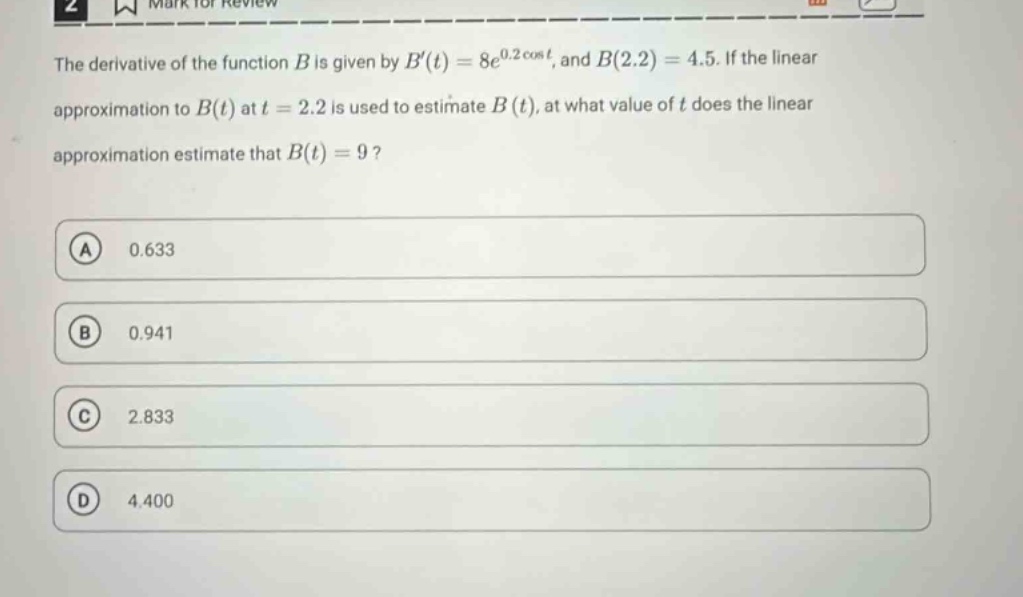
the derivative of the function b is given by b(t)=8e^{0.2cos t}, and b(2.2)=4.5. if the linear approximation to b(t) at t = 2.2 is used to estimate b(t), at what value of t does the linear approximation estimate that b(t)=9?\na 0.633\nb 0.941\nc 2.833\nd 4.400
Answer
Explanation:
Step1: Recall linear - approximation formula
The linear - approximation formula is $L(t)=B(a)+B^{\prime}(a)(t - a)$, where $a = 2.2$, $B(a)=B(2.2)=4.5$, and $B^{\prime}(t)=8e^{0.2\cos t}$. First, find $B^{\prime}(2.2)$: $B^{\prime}(2.2)=8e^{0.2\cos(2.2)}$. Calculate $\cos(2.2)\approx - 0.5298$. Then $0.2\cos(2.2)\approx0.2\times(-0.5298)=-0.10596$. And $e^{-0.10596}\approx0.899$. So $B^{\prime}(2.2)=8\times0.899 = 7.192$.
Step2: Set up the linear - approximation equation
The linear - approximation $L(t)$ of $B(t)$ at $t = 2.2$ is $L(t)=B(2.2)+B^{\prime}(2.2)(t - 2.2)$. We want to find $t$ when $L(t)=9$. Substitute the known values into the equation: $9 = 4.5+7.192(t - 2.2)$.
Step3: Solve the equation for $t$
First, subtract 4.5 from both sides: $9 - 4.5=7.192(t - 2.2)$. $4.5 = 7.192(t - 2.2)$. Then, divide both sides by 7.192: $t - 2.2=\frac{4.5}{7.192}\approx0.626$. Finally, add 2.2 to both sides: $t=2.2 + 0.626=2.826\approx2.833$.
Answer:
C. 2.833