the derivative of a function f is given by f(x)=e^x - x^3. on which intervals is the graph of f decreasing…
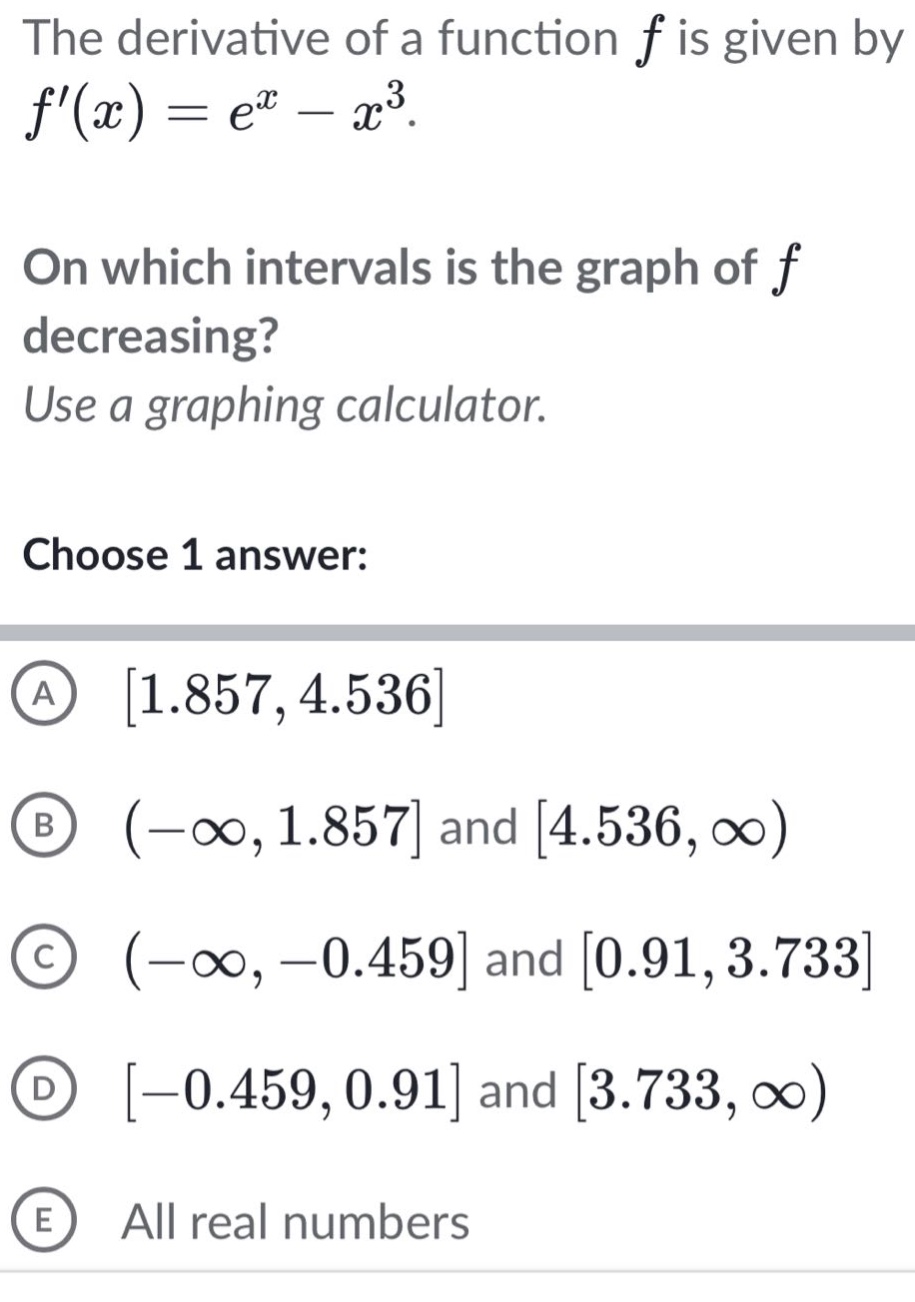
the derivative of a function f is given by f(x)=e^x - x^3. on which intervals is the graph of f decreasing? use a graphing calculator. choose 1 answer: a 1.857,4.536 b (-∞,1.857 and 4.536,∞) c (-∞,-0.459 and 0.91,3.733 d -0.459,0.91 and 3.733,∞) e all real numbers
Answer
Explanation:
Step1: Recall the decreasing - function rule
A function $y = f(x)$ is decreasing when $f'(x)<0$.
Step2: Use a graphing calculator
Graph the function $y = f'(x)=e^{x}-x^{3}$. Find the intervals where the graph of $y = e^{x}-x^{3}$ is below the $x$ - axis. When we graph $y = e^{x}-x^{3}$ using a graphing calculator, we find that $e^{x}-x^{3}<0$ on the interval $[1.857,4.536]$.
Answer:
A. $[1.857,4.536]$