the derivative f(x) is graphed in the figure. fill in the table of values for f(x) given that f(0)=0. x 0 1…
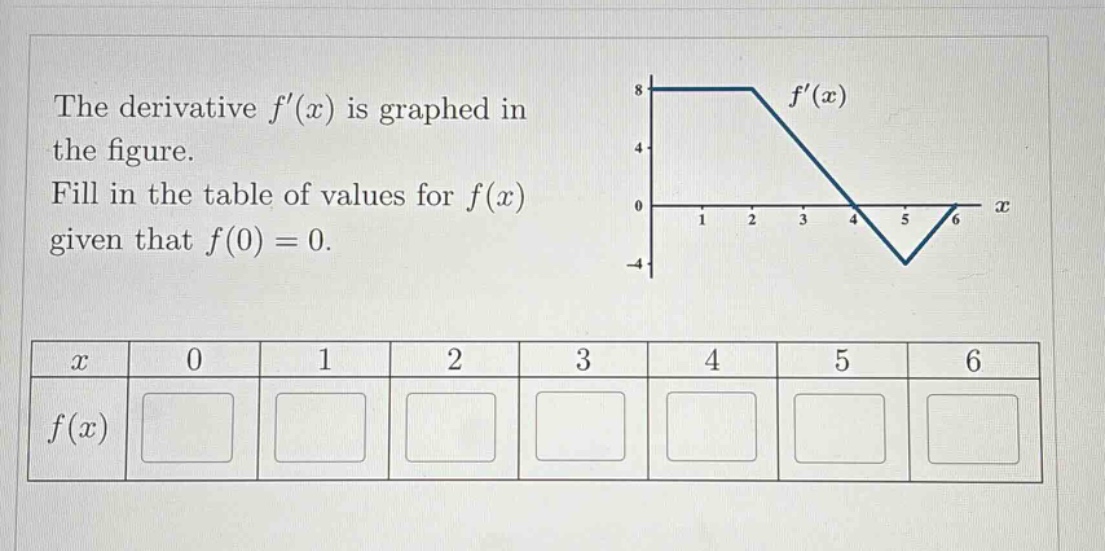
the derivative f(x) is graphed in the figure. fill in the table of values for f(x) given that f(0)=0. x 0 1 2 3 4 5 6 f(x)
Answer
Explanation:
Step1: Recall the fundamental theorem of calculus
The value of $f(x)$ for $x > 0$ can be found using $f(x)-f(0)=\int_{0}^{x}f'(t)dt$. Since $f(0) = 0$, then $f(x)=\int_{0}^{x}f'(t)dt$, and the integral $\int_{0}^{x}f'(t)dt$ is the net - signed area between the graph of $y = f'(t)$ and the $t$ - axis from $t = 0$ to $t=x$.
Step2: Calculate $f(1)$
For $x = 1$, the region under $y = f'(t)$ from $t = 0$ to $t = 1$ is a rectangle with height $h = 8$ and width $w=1$. Using the formula for the area of a rectangle $A=hw$, we have $\int_{0}^{1}f'(t)dt=8\times1 = 8$. So $f(1)=8$.
Step3: Calculate $f(2)$
From $t = 0$ to $t = 2$, the region under $y = f'(t)$ is still a rectangle with height $h = 8$ and width $w = 2$. So $\int_{0}^{2}f'(t)dt=8\times2=16$. So $f(2)=16$.
Step4: Calculate $f(3)$
We can split the integral $\int_{0}^{3}f'(t)dt$ into two parts: $\int_{0}^{2}f'(t)dt+\int_{2}^{3}f'(t)dt$. We know $\int_{0}^{2}f'(t)dt = 16$. The region from $t = 2$ to $t = 3$ is also a rectangle with height $h = 8$ and width $w = 1$. So $\int_{2}^{3}f'(t)dt=8\times1 = 8$. Then $\int_{0}^{3}f'(t)dt=16 + 8=24$. So $f(3)=24$.
Step5: Calculate $f(4)$
We split $\int_{0}^{4}f'(t)dt$ into $\int_{0}^{3}f'(t)dt+\int_{3}^{4}f'(t)dt$. $\int_{0}^{3}f'(t)dt = 24$, and the region from $t = 3$ to $t = 4$ is a trapezoid with bases $b_1=8$ and $b_2 = 0$ and height $h = 1$. Using the formula for the area of a trapezoid $A=\frac{(b_1 + b_2)h}{2}=\frac{(8 + 0)\times1}{2}=4$. So $\int_{0}^{4}f'(t)dt=24+4 = 28$. So $f(4)=28$.
Step6: Calculate $f(5)$
We split $\int_{0}^{5}f'(t)dt$ into $\int_{0}^{4}f'(t)dt+\int_{4}^{5}f'(t)dt$. $\int_{0}^{4}f'(t)dt = 28$, and the region from $t = 4$ to $t = 5$ is a triangle with base $b = 1$ and height $h=- 4$. Using the formula for the area of a triangle $A=\frac{1}{2}bh=\frac{1}{2}\times1\times(-4)=-2$. So $\int_{0}^{5}f'(t)dt=28-2 = 26$. So $f(5)=26$.
Step7: Calculate $f(6)$
We split $\int_{0}^{6}f'(t)dt$ into $\int_{0}^{5}f'(t)dt+\int_{5}^{6}f'(t)dt$. $\int_{0}^{5}f'(t)dt = 26$, and the region from $t = 5$ to $t = 6$ is a triangle with base $b = 1$ and height $h = 4$. Using the formula for the area of a triangle $A=\frac{1}{2}bh=\frac{1}{2}\times1\times4 = 2$. So $\int_{0}^{6}f'(t)dt=26 + 2=28$. So $f(6)=28$.
Answer:
| $x$ | $0$ | $1$ | $2$ | $3$ | $4$ | $5$ | $6$ |
|---|---|---|---|---|---|---|---|
| $f(x)$ | $0$ | $8$ | $16$ | $24$ | $28$ | $26$ | $28$ |