describe the behavior of the function by determining over which interval the function has a negative average…
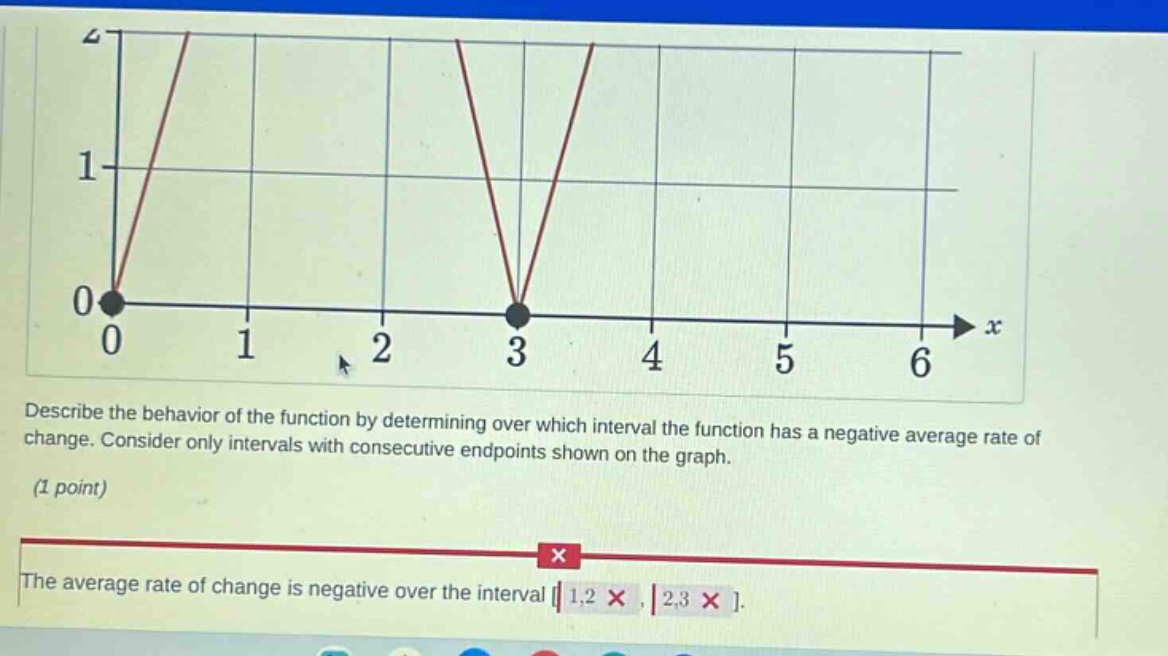
describe the behavior of the function by determining over which interval the function has a negative average rate of change. consider only intervals with consecutive endpoints shown on the graph. (1 point) the average rate of change is negative over the interval 1,2 ×, 2,3 × .
Answer
Explanation:
Step1: Definir la tasa de cambio promedio
La tasa de cambio promedio de una función $y = f(x)$ en el intervalo $[a,b]$ está dada por $\frac{f(b)-f(a)}{b - a}$. Queremos cuando $\frac{f(b)-f(a)}{b - a}<0$.
Step2: Analizar intervalos
- En el intervalo $[0,1]$: Si $a = 0$, $b = 1$, y observando el gráfico, $f(1)>f(0)$, entonces $\frac{f(1)-f(0)}{1 - 0}=f(1)-f(0)>0$.
- En el intervalo $[1,2]$: La función es constante, es decir $f(2)=f(1)$, entonces $\frac{f(2)-f(1)}{2 - 1}=0$.
- En el intervalo $[2,3]$: Si $a = 2$, $b = 3$, y observando el gráfico, $f(3)<f(2)$, entonces $\frac{f(3)-f(2)}{3 - 2}=f(3)-f(2)<0$.
- En el intervalo $[3,4]$: Si $a = 3$, $b = 4$, $f(4)>f(3)$, entonces $\frac{f(4)-f(3)}{4 - 3}=f(4)-f(3)>0$.
Answer:
$[2,3]$