describe the end behavior of f(x)=(3x - 1)/(x^2 + 4x - 2) as x→∞? 1/21 f(x)→1/21 3 f(x)→3 0 f(x)→0 1/3…
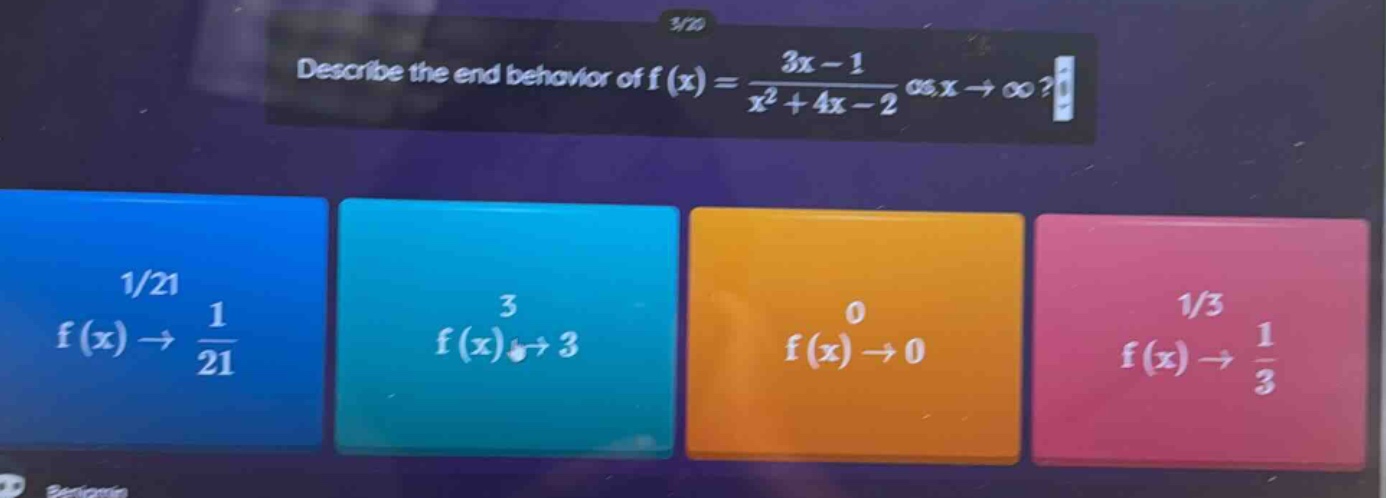
describe the end behavior of f(x)=(3x - 1)/(x^2 + 4x - 2) as x→∞? 1/21 f(x)→1/21 3 f(x)→3 0 f(x)→0 1/3 f(x)→1/3
Answer
Explanation:
Step1: Divide numerator and denominator by highest - power of x
Divide both the numerator and denominator of $f(x)=\frac{3x - 1}{x^{2}+4x - 2}$ by $x^{2}$ (since the highest - power of $x$ in the denominator is 2). We get $f(x)=\frac{\frac{3x}{x^{2}}-\frac{1}{x^{2}}}{\frac{x^{2}}{x^{2}}+\frac{4x}{x^{2}}-\frac{2}{x^{2}}}=\frac{\frac{3}{x}-\frac{1}{x^{2}}}{1 + \frac{4}{x}-\frac{2}{x^{2}}}$.
Step2: Evaluate the limit as $x\to\infty$
As $x\to\infty$, we know that $\lim_{x\to\infty}\frac{1}{x}=0$ and $\lim_{x\to\infty}\frac{1}{x^{2}} = 0$. Then $\lim_{x\to\infty}f(x)=\lim_{x\to\infty}\frac{\frac{3}{x}-\frac{1}{x^{2}}}{1+\frac{4}{x}-\frac{2}{x^{2}}}=\frac{0 - 0}{1+0 - 0}=0$.
Answer:
C. $f(x)\to0$