describe the end behavior of f(x) as x approaches negative infinity? f(x)=(x^3 + 2x^2 - 5x + 2)/(x^2 - x…
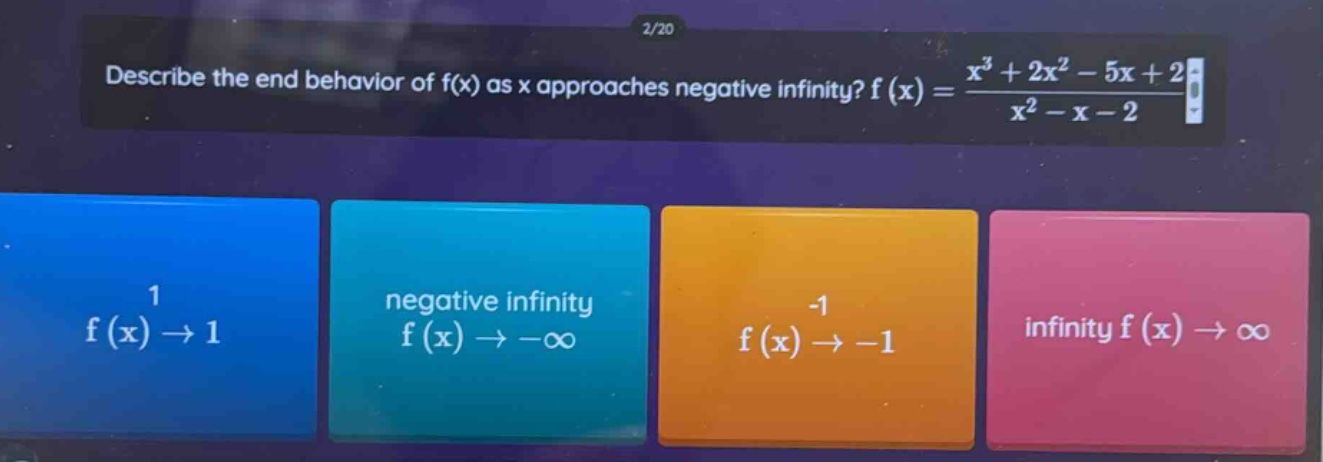
describe the end behavior of f(x) as x approaches negative infinity? f(x)=(x^3 + 2x^2 - 5x + 2)/(x^2 - x - 2) 1 f(x)→1 negative infinity f(x)→−∞ -1 f(x)→−1 infinity f(x)→∞
Answer
Explanation:
Step1: Divide numerator and denominator by highest - power of x
Divide $\frac{x^{3}+2x^{2}-5x + 2}{x^{2}-x - 2}$ by $x^{2}$. We get $\frac{x + 2-\frac{5}{x}+\frac{2}{x^{2}}}{1-\frac{1}{x}-\frac{2}{x^{2}}}$.
Step2: Evaluate limit as x approaches negative infinity
As $x\to-\infty$, $\frac{5}{x}\to0$, $\frac{2}{x^{2}}\to0$, $\frac{1}{x}\to0$. Then $\lim_{x\to-\infty}\frac{x + 2-\frac{5}{x}+\frac{2}{x^{2}}}{1-\frac{1}{x}-\frac{2}{x^{2}}}=\lim_{x\to-\infty}(x + 2)$.
Step3: Determine end - behavior
As $x\to-\infty$, $x+2\to-\infty$.
Answer:
negative infinity $f(x)\to-\infty$